Walking for fitness: how much, how fast and how to start
Walking for fitness, from the guidelines: how many minutes a week, how to judge a brisk pace, how to build up, and what step counts really show.
- Published
- Last checked

Walking is one of the simplest ways to meet the physical activity guidelines. It needs no gym, no special skill and very little kit. Done at a brisk pace, it counts as the moderate-intensity activity that public health guidelines ask adults to do every week [5][6].
This guide sets out what the World Health Organization (WHO), the US Centers for Disease Control and Prevention (CDC) and the NHS in the UK say about walking for fitness. It covers how much to aim for, how fast "brisk" is, how to build up from a low start, and what the research on step counts shows. It is general guidance for adults. If you have a heart condition or another long-term health condition, read the last section before you start.
Can you get fit by walking?
Yes. WHO describes aerobic activity as movement in which the body's large muscles work in a rhythm for a sustained period, and it names walking as an example. This kind of activity improves cardiorespiratory fitness, the fitness of your heart and lungs [2]. For the weekly guideline targets, pace matters: the CDC and the NHS both list brisk walking as an example of moderate-intensity activity [5][7].
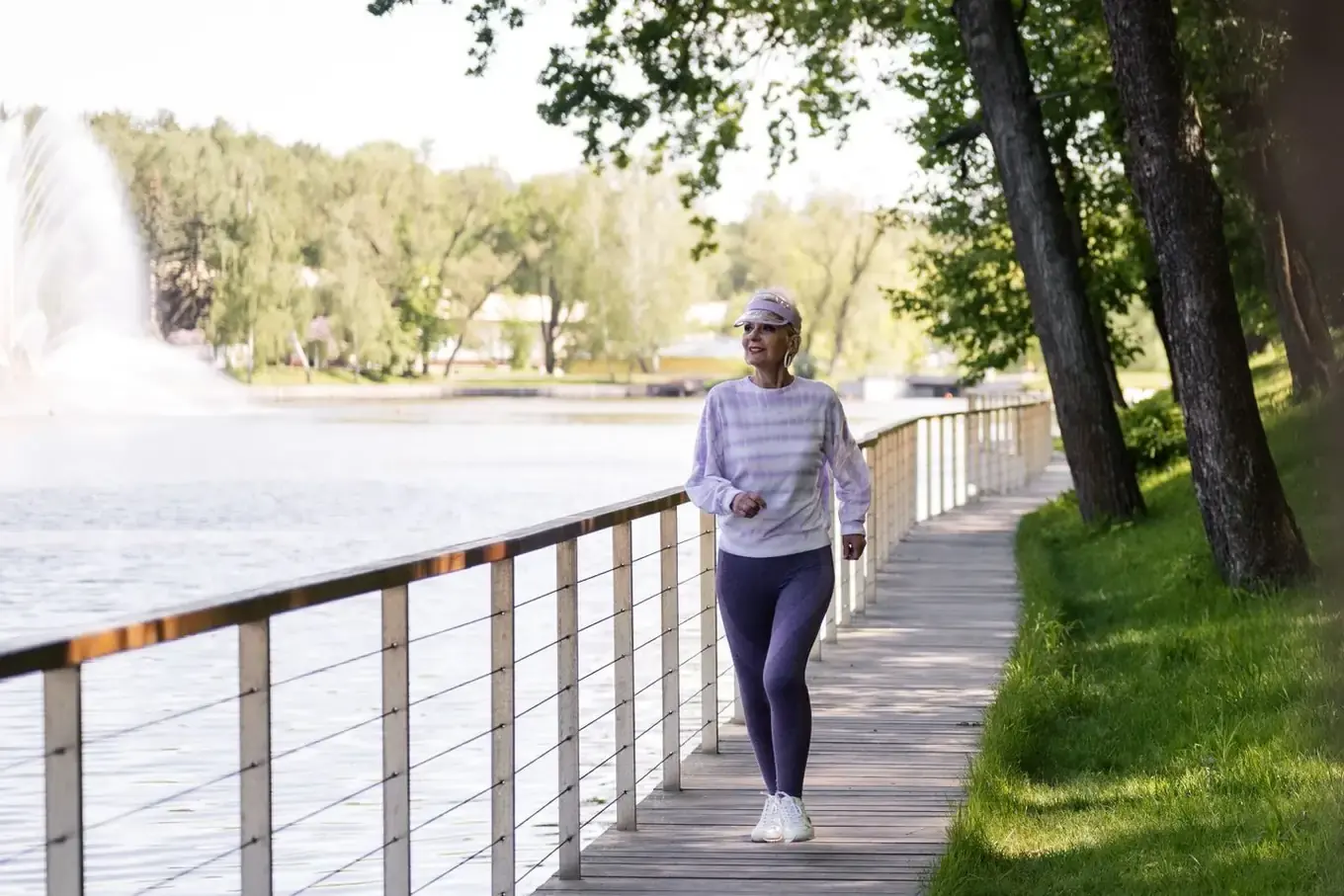
WHO lists the benefits of regular physical activity for adults. They include a lower risk of death from any cause and from heart disease, a lower risk of high blood pressure and of some cancers, and better mental health, thinking and sleep [3]. The NHS says that walking briskly can help you build stamina and make your heart healthier [4].
WHO counts slow walking as light activity [2]. Light activity still has value: the US guidelines say people likely gain some health benefits when they replace sitting time with light activity [8]. But the weekly targets below count moderate or vigorous activity, so brisk walking is the part that moves you towards them.
How much walking do you need?
The main guidelines share the same starting point for adults: 150 minutes of moderate-intensity activity a week.
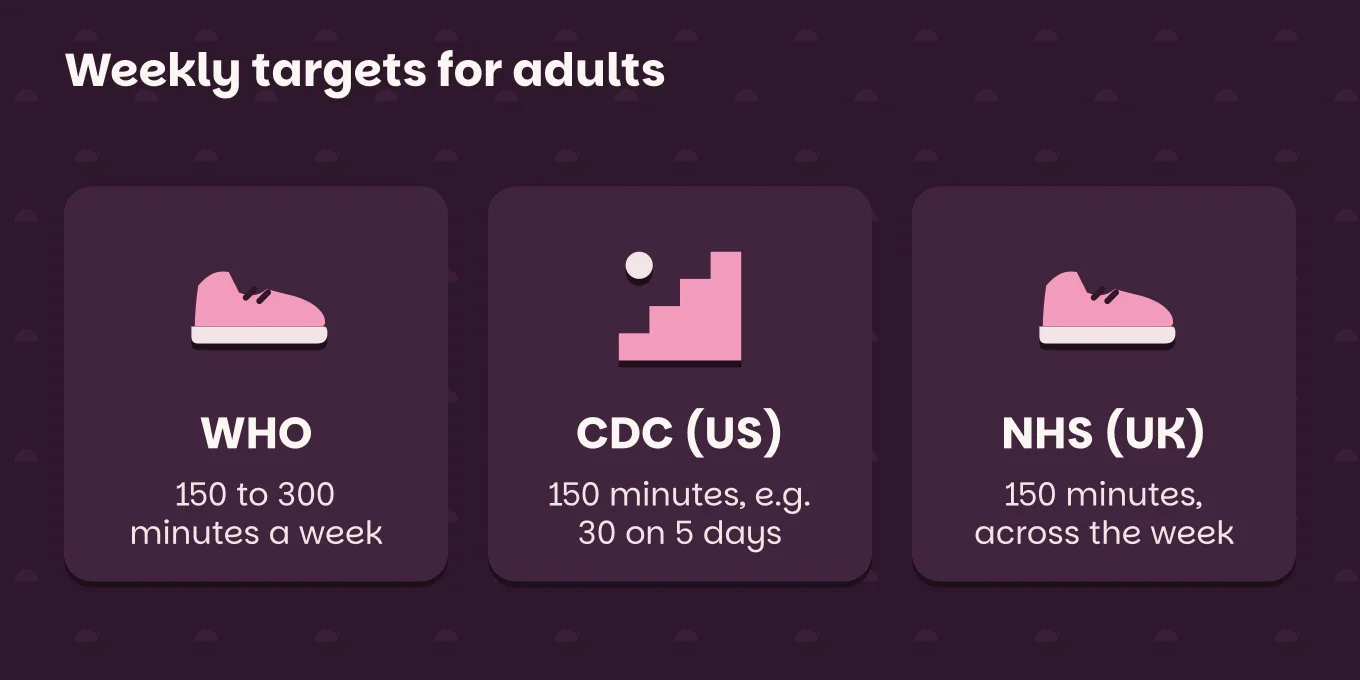
- WHO: at least 150 to 300 minutes of moderate-intensity aerobic activity a week, or 75 to 150 minutes of vigorous activity, or a mix of the 2 [1][2].
- CDC (US): 150 minutes of moderate-intensity activity, such as brisk walking, every week. For example, 30 minutes a day, 5 days a week [6].
- NHS (UK): at least 150 minutes of moderate activity or 75 minutes of vigorous activity a week, spread across 4 to 5 days a week, or every day [5].
Guideline figure: adults should do at least 150 to 300 minutes of moderate-intensity aerobic activity a week, or 75 to 150 minutes of vigorous activity, or a mix. Source: WHO, "WHO guidelines on physical activity and sedentary behaviour", published 25 Nov 2020 [1]. United States: 150 minutes of moderate-intensity activity a week. Source: CDC, "Adult Activity: An Overview", page dated 20 Dec 2023 [6]. United Kingdom: at least 150 minutes of moderate activity or 75 minutes of vigorous activity a week. Source: NHS, "Physical activity guidelines for adults aged 19 to 64", page last reviewed 22 May 2024 [5]. We checked these figures on 18 Oct 2026. We recheck guideline figures every 6 months, so our next check is due by 18 Apr 2027.
All 3 also ask adults to do muscle-strengthening activities on at least 2 days a week [1][5][6]. Walking does not cover that part, so it works best next to some strength work.
Figure 1 compares the 3 weekly targets: 150 to 300 minutes a week from WHO, 150 minutes a week from the CDC (US), for example 30 minutes on 5 days, and 150 minutes a week from the NHS (UK), spread across the week.
You do not need long walks to get there. WHO and the US guidelines both dropped the old rule that activity had to come in bouts of at least 10 minutes. Bouts of any length now count towards the weekly total [2][8]. The NHS says a brisk 10-minute daily walk has lots of health benefits and counts towards your 150 minutes [4].
If 150 minutes sounds like a lot, treat it as a target, not a starting line. WHO says that some physical activity is better than none [2]. In the US guidelines, the biggest gain in benefit came when people went from no activity to just 60 minutes a week [8].
How fast should you walk?
"Brisk" is about effort, not a set speed. There are 3 simple ways to check it.
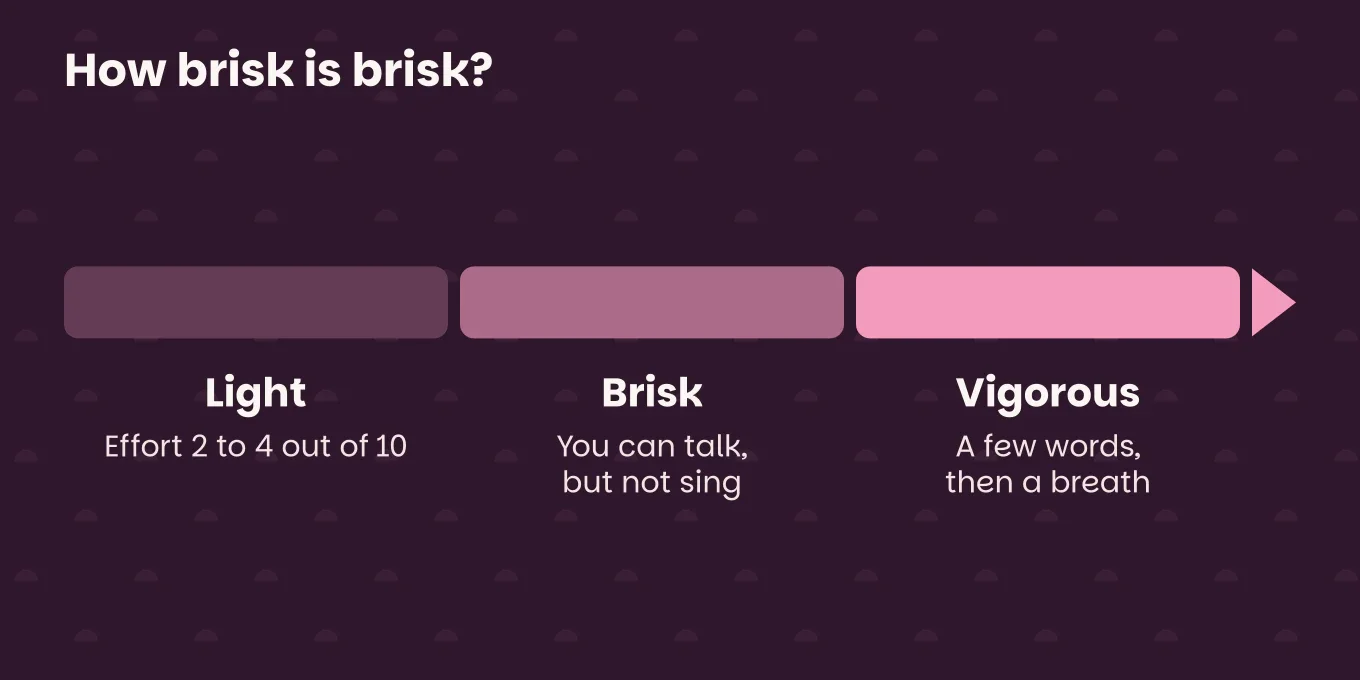
The talk test. The NHS says you are walking briskly if you can still talk but cannot sing the words to a song [4]. The CDC and the US guidelines use the same rule of thumb. During moderate activity you can talk, but not sing. During vigorous activity you cannot say more than a few words without pausing for a breath [7][8].
The effort scale. Rate your effort from 0 to 10, where sitting is 0 and your hardest effort is 10. Moderate activity is a 5 or 6, and vigorous activity starts at 7 or 8 [7][8]. WHO rates light activity, such as slow walking, at 2 to 4 [2].
Speed. The NHS (UK) puts a brisk walk at about 3 miles an hour, which is about 4.8 km an hour [4]. The CDC (US) counts walking at 2.5 miles an hour or faster, about 4 km an hour, as brisk [7].
Guideline figure: United States: during moderate activity you can talk, but not sing; it is an effort of 5 or 6 on a scale of 0 to 10; and walking at 2.5 miles an hour or faster is brisk. Source: CDC, "How to Measure Physical Activity Intensity", page dated 4 Dec 2025 [7]. United Kingdom: a brisk walk is about 3 miles an hour, and you can still talk but cannot sing. Source: NHS, "Walking for health", page last reviewed 15 Dec 2022 [4]. We checked these figures on 18 Oct 2026. We recheck guideline figures every 6 months, so our next check is due by 18 Apr 2027.
The effort scale measures effort against your own fitness. Less fit people generally need more effort than fitter people to do the same activity [8]. So the same walking speed can be brisk for 1 person and easy for another, which is why an effort check is more useful than a speed.
Figure 2 shows the effort range from light to vigorous. Light activity is an effort of 2 to 4 out of 10. Brisk walking means you can talk, but not sing. Vigorous activity means you can say only a few words before you need a breath.
How to start if you are not very active
Every source here gives the same advice: start small and build up slowly.
- The US guidelines say inactive people should "start low and go slow", with lower intensity activities at first, then gradually do them more often and for longer [8].
- WHO says to start with small amounts of physical activity and gradually increase how often, how hard and how long you do it [2].
- The NHS says that if you are not very active but are able to walk, you should increase your walking distance gradually [4].
- The US National Heart, Lung, and Blood Institute (NHLBI) notes that many people like to start with walking and slowly increase their time and distance [9].
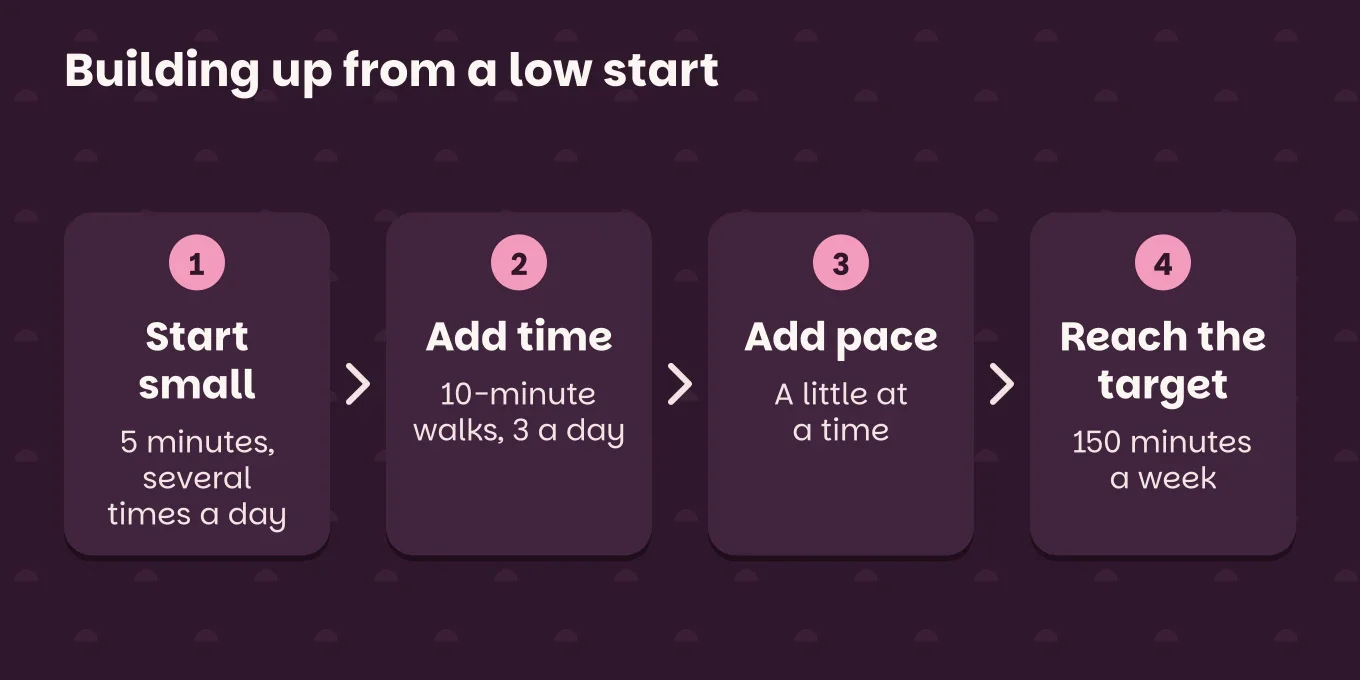
The US guidelines give a worked example for an inactive adult. Start with 5 minutes of walking several times a day, 5 to 6 days a week. Gradually build up to 10 minutes at a time, 3 times a day. Then raise the walking speed slowly [8]. They add that the risk of injury depends on the gap between what you usually do and the new level, so increases should come gradually over weeks to months [8].
Figure 3 shows that path in 4 steps: start small, with 5 minutes several times a day; add time, up to 10-minute walks 3 times a day; then add pace, a little at a time; and reach the target of 150 minutes a week.
Do you need to see a doctor first? The sources differ a little. WHO says a medical check before you start is generally unnecessary for people without a medical reason to avoid exercise, as long as the activity is no harder than brisk walking or everyday living [2]. The NHS (UK) says to speak to your GP first if you have not exercised for some time, or if you have medical conditions or concerns [5]. The US guidelines and the NHLBI agree with WHO for healthy adults: you do not need to check with a doctor before you build up gradually or start moderate activity [8][9]. So the NHS is the more cautious source. The NHLBI (US) adds that if you have a heart problem or a long-term disease, you should ask your doctor what types of activity are safe for you [9].
What about 10,000 steps a day?
You have probably heard that 10,000 steps a day is the goal. The US guidelines say this popular advice "is not a guideline per se", but a way people may choose to meet the guidelines [8]. The authors of a 2022 meta-analysis write that the 10,000 goal is not based on evidence. They trace it to a marketing campaign in Japan [10].
That meta-analysis, led by Amanda Paluch and published in The Lancet Public Health, pooled 15 studies of 47,471 adults whose steps were measured with a device. People were followed for a median of 7.1 years [10]. Within each study, the authors split people into 4 equal groups by daily steps. They compared each group with the group taking the fewest steps, a median of 3,553 a day:
- At a median of 5,801 steps a day, the risk of death during follow-up was about 40% lower.
- At a median of 7,842 steps a day, it was about 45% lower.
- At a median of 10,901 steps a day, it was about 53% lower.
The risk kept falling as steps rose, then levelled off. For adults aged 60 and over, the curve flattened at about 6,000 to 8,000 steps a day. For younger adults, it flattened at about 8,000 to 10,000 steps a day [10]. The authors found no clear answer on whether faster stepping adds benefit beyond the total number of steps [10].
These results describe risk, not targets, and the study has limits. It was observational, so it cannot show that the steps caused the lower risk. All the studies took place in high-income countries, and most participants were White volunteers. Step counts from different devices can also differ by 20% or more [10].
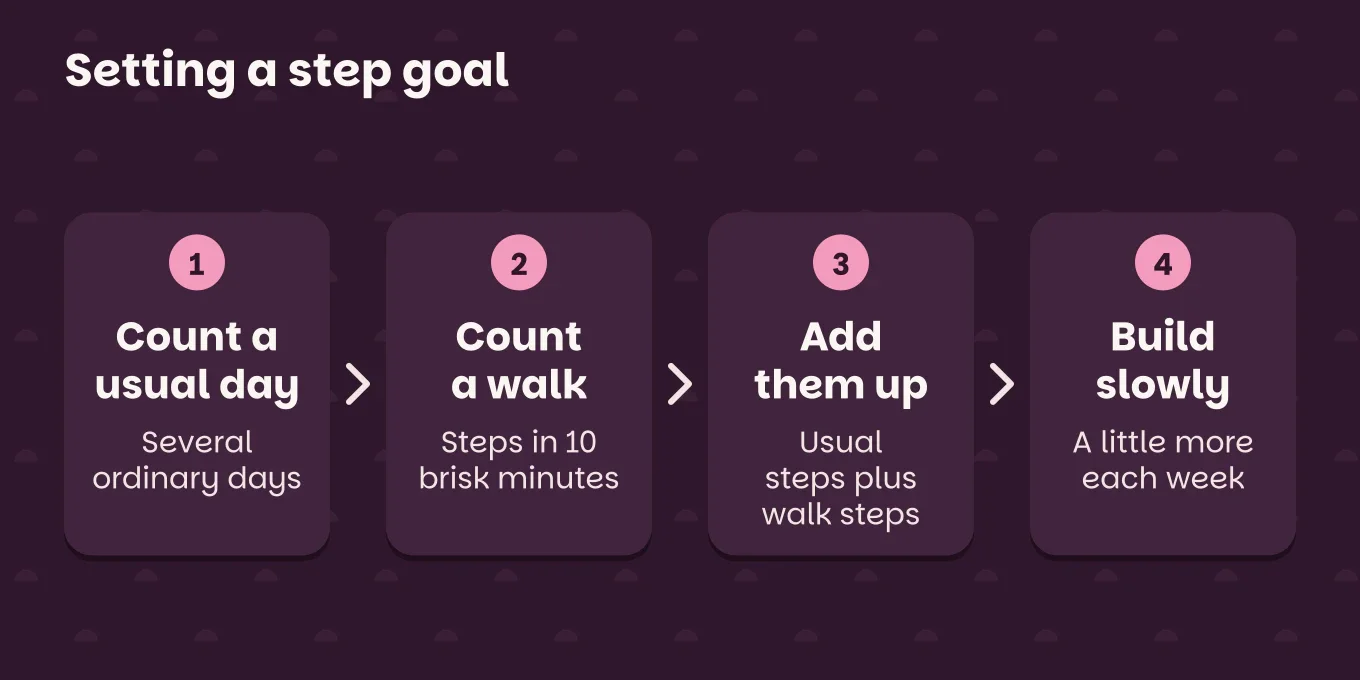
If you like numbers, the US guidelines suggest that you set a time goal first and then work out the steps to match [8]:
- Count your usual daily steps on several ordinary days without a walk for exercise.
- Count the steps you take in a 10-minute brisk walk.
- Multiply that by your walking goal in 10-minute blocks, and add it to your usual steps. In the guidelines' example, a usual 5,000 steps plus a 20-minute walk of 2,000 steps gives a goal of 7,000 steps a day.
- Raise your daily total a little each week until you reach the goal.
Figure 4 shows these 4 steps: count a usual day, over several ordinary days; count a walk, the steps in 10 brisk minutes; add them up, your usual steps plus your walk steps; and build slowly, a little more each week.
How to make walking a habit
The easiest way to walk more is to fit it into the day you already have. The NHS suggests [4]:
- walking part of your journey to work
- walking to the shops
- using the stairs instead of the lift
- leaving the car behind for short journeys
- a regular walk with a friend
- a stroll with family or friends after dinner
A few more ideas help you keep going:
- Listen to something. Music or a podcast can take your mind off the effort and help you walk faster [4].
- Change your route. Parks, towpaths, riverside paths and woodlands all make good walks, in towns as well as the countryside [4].
- Walk with others. A walking group is a way to start, meet people and stay motivated [4]. Friends and family can help you stay active [9].
- Keep track. A log or a step counter can help you set goals and stay motivated [9].

How to stay safe and comfortable
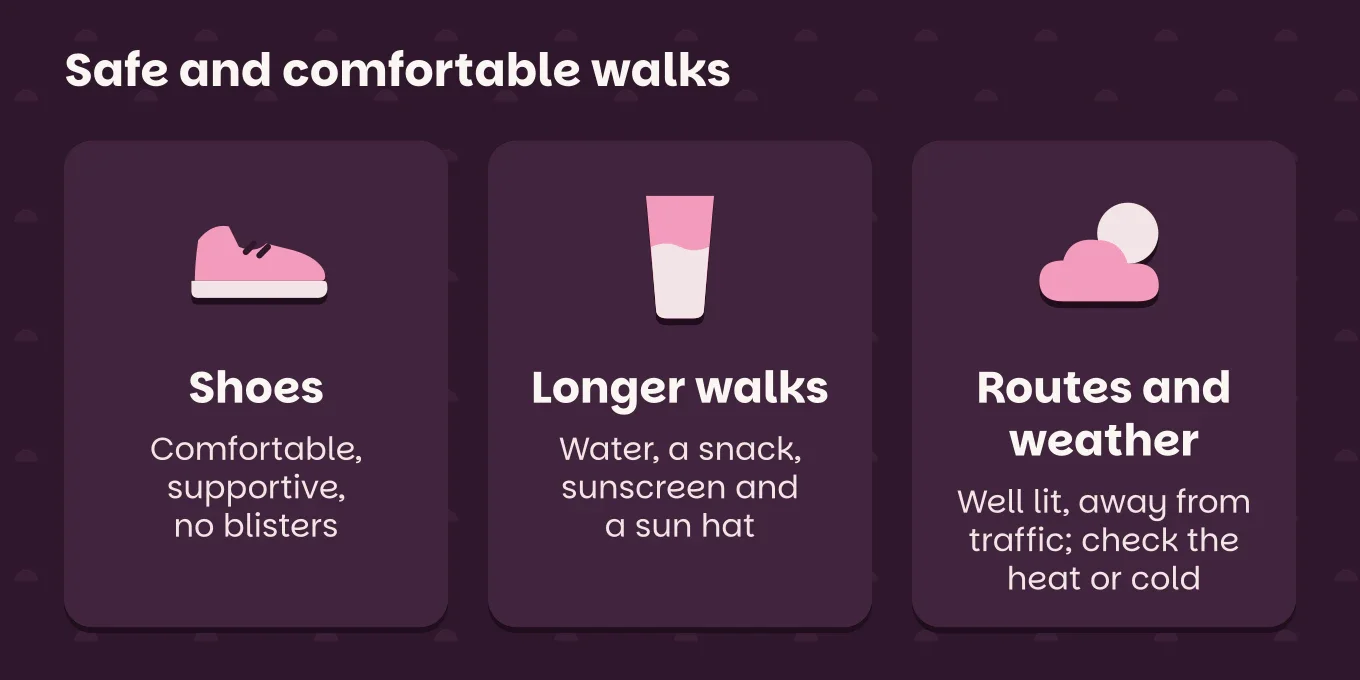
- Shoes: any comfortable shoes or trainers will do, as long as they give enough support and do not cause blisters [4].
- Longer walks: take water, a snack, a spare top, sunscreen and a sun hat [4].
- Routes: pick places that are well lit, well kept and clearly separated from car traffic [9].
- Weather: think about how hot or cold it is, and change your plans if you need to [9].
- New symptoms: WHO says people who develop new symptoms as they increase their activity should see a healthcare provider [2].
The figure below groups the first 4 points under 3 headings: shoes, longer walks, and routes and weather.
See a doctor if
- You have chest pain or dizziness during physical activity [11].
- You have chest pain that comes and goes, or chest pain that went away quickly but still worries you [12].
- Joint pain stops you doing normal activities or affects your sleep, gets worse or keeps coming back, or has not improved after 2 weeks of looking after it at home [13].
- You notice new symptoms as you walk more or faster [2].
- You have a heart problem or a long-term disease, such as heart disease or high blood pressure, and have not yet asked your doctor which activities are safe for you [9].
- These chest symptoms are an emergency. In the UK, the NHS says to call 999; elsewhere, call your local emergency number [12]:
- sudden pain or discomfort in your chest that does not go away, which can feel like squeezing or pressure, burning or indigestion
- pain that spreads to your left or right arm, or your neck, jaw, stomach or back
- chest pain with feeling sweaty, sick, light-headed or short of breath
- These joint symptoms need emergency care. In the UK, the NHS says to go to A&E or call 999; elsewhere, call your local emergency number [13]:
- very bad joint pain after a fall or injury
- not being able to walk or put weight on a joint
- a joint that has moved out of place
- tingling or no feeling in the area around the joint after an injury
How we made this article. We researched it with AI assistance. We then fact-checked every claim against the sources below. Editorial policy
Sources
All sources checked . Found an error? Tell us.
- 1World Health Organization. WHO guidelines on physical activity and sedentary behaviour (opens in a new tab). who.int. Published 25 November 2020. Checked 18 October 2026.
- 2Bull FC, Al-Ansari SS, Biddle S, et al. World Health Organization 2020 guidelines on physical activity and sedentary behaviour (opens in a new tab). British Journal of Sports Medicine, volume 54, pages 1451 to 1462. Published December 2020. Checked 18 October 2026.
- 3World Health Organization. Physical activity (opens in a new tab). who.int fact sheet. Published 26 June 2024. Checked 18 October 2026.
- 4NHS (UK). Walking for health (opens in a new tab). nhs.uk. Page last reviewed 15 December 2022; the next review was due 15 December 2025. Checked 18 October 2026.
- 5NHS (UK). Physical activity guidelines for adults aged 19 to 64 (opens in a new tab). nhs.uk. Page last reviewed 22 May 2024. Checked 18 October 2026.
- 6Centers for Disease Control and Prevention (US). Adult Activity: An Overview (opens in a new tab). cdc.gov. Page dated 20 December 2023. Checked 18 October 2026.
- 7Centers for Disease Control and Prevention (US). How to Measure Physical Activity Intensity (opens in a new tab). cdc.gov. Page dated 4 December 2025. Checked 18 October 2026.
- 8US Department of Health and Human Services. Physical Activity Guidelines for Americans, 2nd edition (opens in a new tab). health.gov. Published 2018; still the current edition. Pages 8, 10, 23, 58, 60, 62, 111 and 112. Checked 18 October 2026.
- 9National Heart, Lung, and Blood Institute (US). Physical Activity and Your Heart: Getting Started and Staying Active (opens in a new tab). nhlbi.nih.gov. Last updated 24 March 2022. Checked 18 October 2026.
- 10Paluch AE, Bajpai S, Bassett DR, et al. Daily steps and all-cause mortality: a meta-analysis of 15 international cohorts (opens in a new tab). The Lancet Public Health, volume 7, pages e219 to e228. Published March 2022. Checked 18 October 2026.
- 11National Heart, Lung, and Blood Institute (US). Physical Activity and Your Heart: Risks (opens in a new tab). nhlbi.nih.gov. Last updated 24 March 2022. Checked 18 October 2026.
- 12NHS (UK). Chest pain (opens in a new tab). nhs.uk. Page last reviewed 8 August 2023; the next review was due 8 August 2026. Checked 18 October 2026.
- 13NHS (UK). Joint pain (opens in a new tab). nhs.uk. Page last reviewed 26 February 2026. Checked 18 October 2026.