Stress management techniques for everyday stress
Stress management techniques from WHO, NHS and US guidance: spot your stress signs, take back control, move, rest, connect, and know when to get help.
- Published
- Last checked
Need help right now?
In an emergency, call your local emergency number.
Find A HelplineFree, confidential support from a helpline near you, by online chat, text or phone.
Everyone feels stressed at times. A deadline, a money worry or a row at home can all set it off. Stress management is not about removing every pressure from your life. It is about a set of small, repeatable habits that help you cope while the pressure lasts.
This guide brings together the stress management techniques that the World Health Organization (WHO), the NHS in the UK, and the US National Institute of Mental Health (NIMH) and Centers for Disease Control and Prevention (CDC) suggest. It is about everyday stress. It is not a guide to anxiety disorders or any other condition. If stress is with you most of the time, the last section lists the signs that it is time to talk to a doctor.
What stress is, and how it shows up
WHO defines stress as a state of worry or mental tension caused by a difficult situation. It is a natural human response that prompts us to deal with challenges and threats. A little stress is good and can help us get through daily tasks. Too much can cause physical and mental health problems [1].
The CDC (US) calls stress your body's physical and emotional response to new or challenging situations, and a normal part of life. Stress that lasts a long time can make health problems worse [2]. NIMH (US) adds that stress is generally a response to an outside cause, such as a big test or an argument, and goes away once the situation is resolved [3].
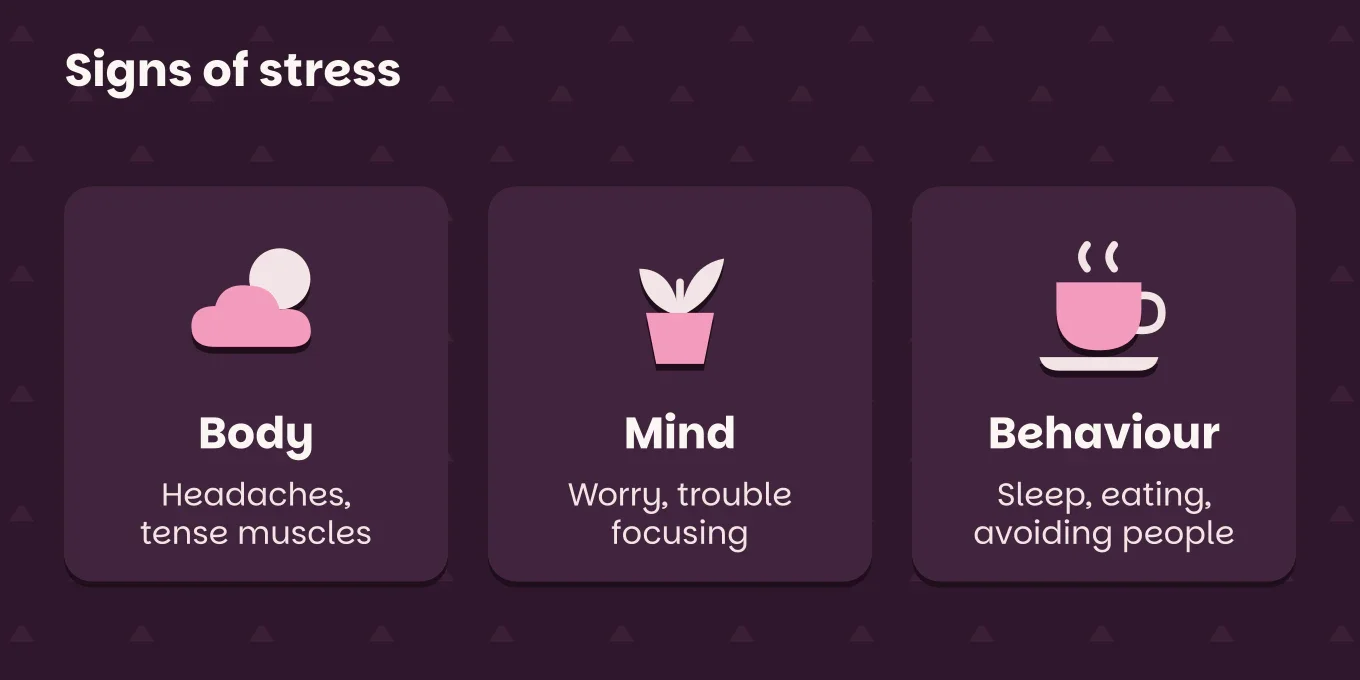
Stress can show up in your body, your mind and your behaviour. The NHS (UK) lists signs such as [4]:
- Body: headaches or dizziness, muscle tension or pain, stomach problems, chest pain or a faster heartbeat.
- Mind: difficulty concentrating, struggling to make decisions, feeling overwhelmed, constant worry, being forgetful.
- Behaviour: being irritable and snappy, sleeping or eating too much or too little, avoiding certain places or people, drinking or smoking more.
It is not always easy to tell that stress is the reason you feel or act differently [4].
Figure 1 groups the signs in 3 columns: the body, with headaches and tense muscles; the mind, with worry and trouble focusing; and behaviour, with changes in sleep and eating, and avoiding people.
1. Find what is causing your stress
The NHS says the first step to feeling better is to identify the cause [6]. If you know what is causing your stress, it may be easier to find ways to manage it [4]. Common causes include pressure at work, relationship problems, money worries and health problems, for you or someone close to you [4][5].
NIMH suggests learning what triggers your stress and which coping techniques work for you. It may take some trial and error to find what works best [3].
A simple way to start is to note, for a week, when you felt stressed, what was happening and how you reacted. NIMH and the CDC both list keeping a journal as a way to cope with stress [2][3]. Over a week, you may start to see patterns, such as the same meeting, the same time of day or the same kind of task.

2. Change what you can, and accept what you cannot
The NHS (UK) names a feeling of losing control as one of the main causes of stress, and says that taking control can be empowering [6]. At the same time, some situations cannot be changed. The NHS suggests that you focus on the things you do have control over [6]. If your company is making redundancies, for example, you could focus on looking for a new job [6].
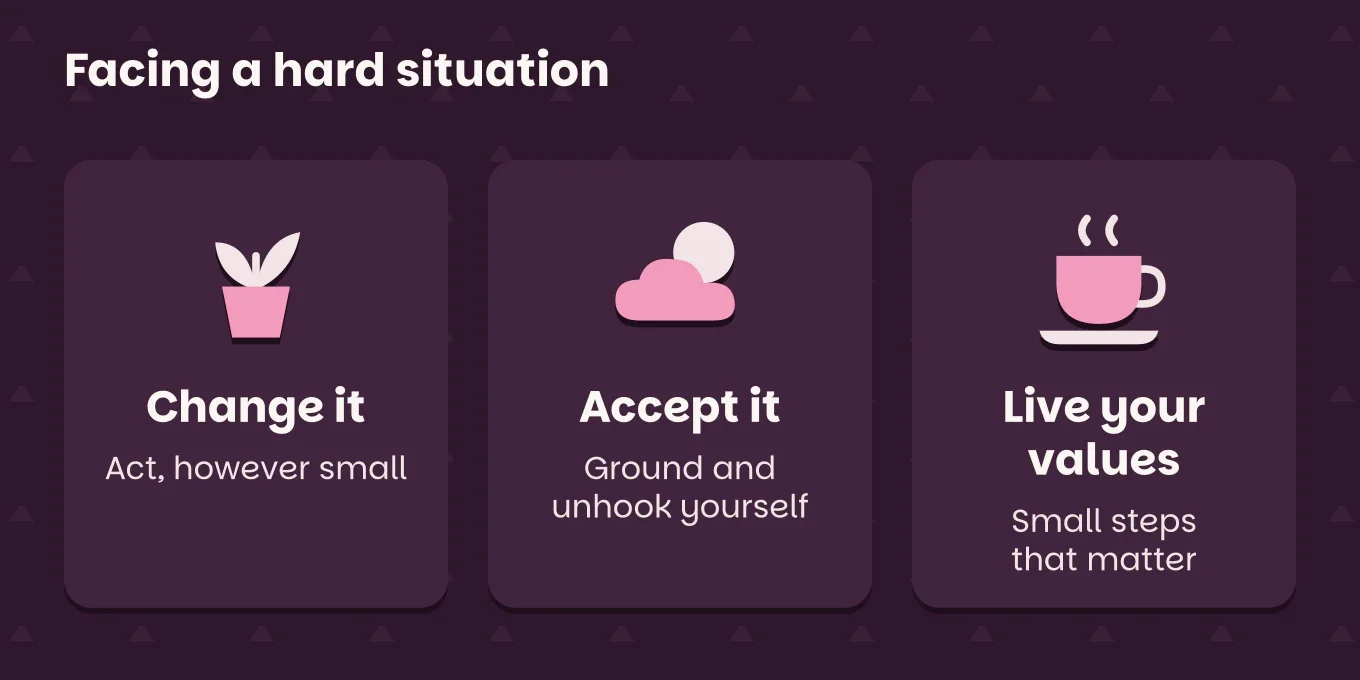
WHO's self-help guide, Doing What Matters in Times of Stress, makes a similar point. If you cannot leave a difficult situation, and you do not want to give up on what matters to you, it suggests 3 things together [7]:
- Change what can be changed. Take whatever action you can, however small, to improve the situation.
- Accept the pain that cannot be changed. Ground yourself and unhook from difficult thoughts and feelings, using the skills in section 8.
- Live by your values. Keep acting like the person you want to be, in small ways, every day.
Figure 2 shows these 3 parts side by side: change it, with action however small; accept it, by grounding and unhooking yourself; and live your values, with small steps that matter.
3. Break big tasks down and plan ahead
A long list can feel overwhelming, so cut it into pieces you can manage.
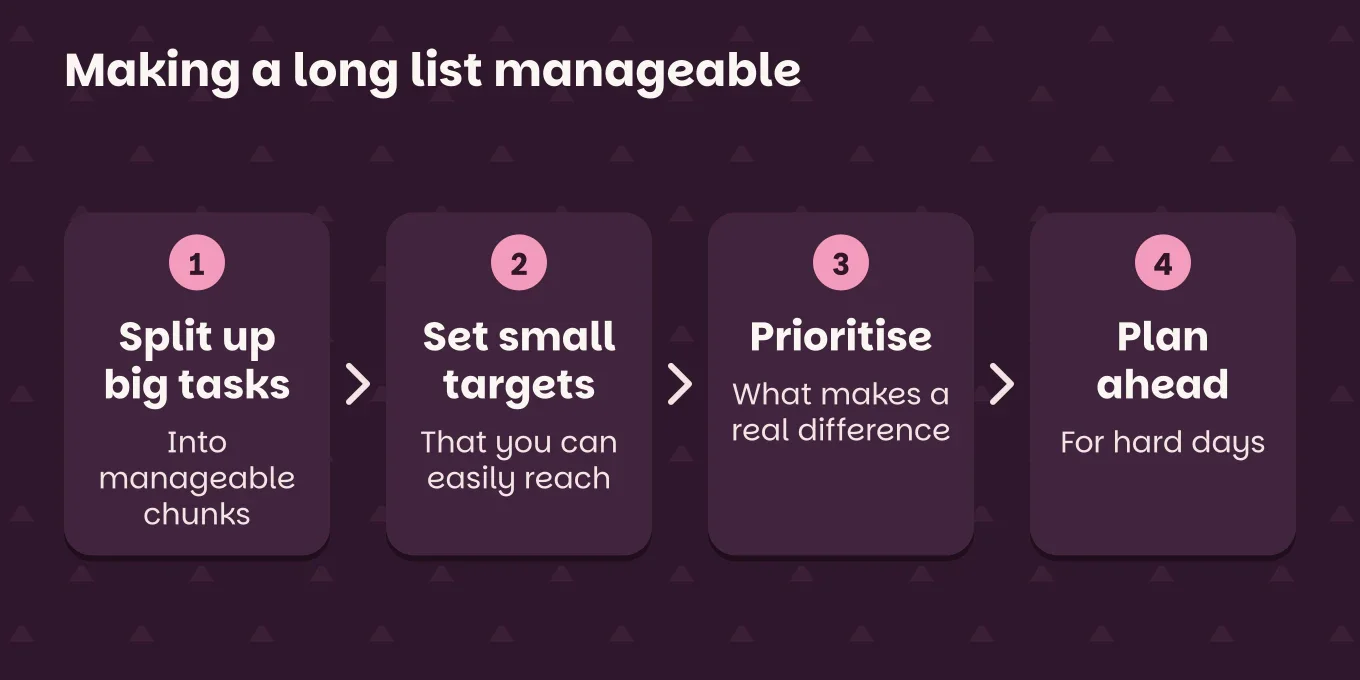
- Split up big tasks. The NHS says you may feel less stressed if you break a task down into easier, more manageable chunks, and give yourself credit when you finish each one [5].
- Do not try to do everything at once. Set small targets that you can easily reach [4].
- Prioritise. Focus on the tasks that will make a real difference, and leave the least important ones to last. Accept that you will not have time for everything [6].
- Plan ahead for hard days. A to-do list, a planned journey or a list of things to take can help before a stressful day or event [5].
The figure below shows these 4 steps: split up big tasks, set small targets, prioritise, and plan ahead for hard days.
A daily routine helps too. WHO says a daily schedule can help you use your time well and feel more in control. It suggests setting time for regular meals, time with family, exercise, daily chores and leisure [1].
4. Move your body
WHO, the NHS, NIMH and the CDC all list physical activity as a way to cope with stress [1][2][3][6]. The NHS (UK) says that exercise will not make your stress disappear, but it can reduce some of its emotional intensity, clear your thoughts, and let you deal with your problems more calmly [6]. WHO says regular daily exercise can help reduce stress, and that walking counts [1].
You do not need a hard workout. The CDC (US) suggests that you start small and build up to 150 minutes, or 2.5 hours, of activity a week [2].

5. Look after sleep, food and daily habits
Stress and sleep affect each other. Sleeping too much or too little is a sign of stress [4], and WHO says sleep can help reverse the effect of stress [1]. The CDC (US) says adults need 7 or more hours a night [2].
Guideline figure: United States: adults need 7 or more hours of sleep a night, and you can start small and build up to 150 minutes (2.5 hours) of activity a week. Source: CDC, "Managing Stress", page dated 12 May 2026 [2]. We checked these figures on 18 Oct 2026. We recheck guideline figures every 6 months, so our next check is due by 18 Apr 2027.
WHO's sleep habits include [1]:
- going to bed and getting up at the same times every day, weekends included
- keeping your bedroom quiet, dark, relaxing and at a comfortable temperature
- limiting screens before bed
- avoiding large meals, caffeine and alcohol before bedtime
Regular meals matter too. NIMH suggests that you eat healthy, regular meals and avoid too much caffeine [3]. WHO suggests a balanced diet, enough fluids, and lots of fresh fruit and vegetables if you can [1].
Watch the quick fixes. Alcohol, smoking and caffeine may bring short-term relief, but the NHS says they will not solve your problems and can create new ones [6]. The NHS also advises against using gambling or drugs to relieve stress, because they can add to poor mental health [4].
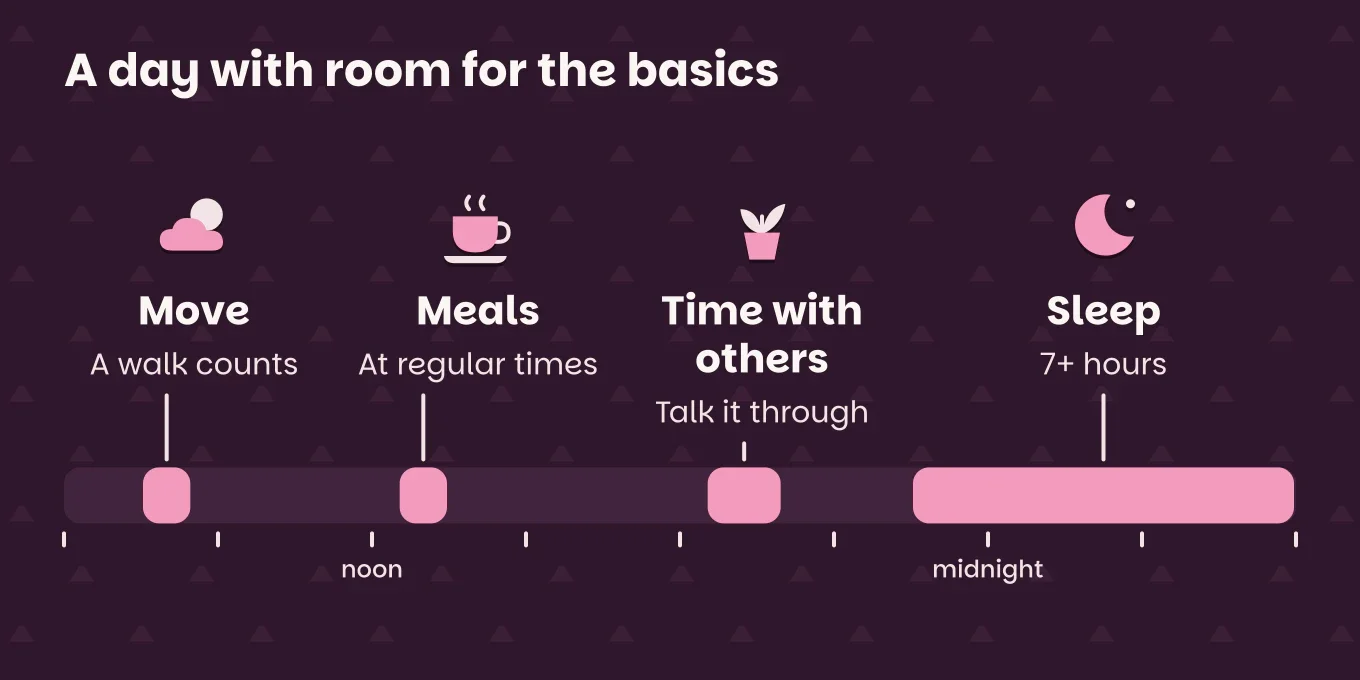
The figure below places these habits on a sample day: time to move in the morning, where a walk counts; meals at midday, at regular times; time with others in the evening, to talk things through; and sleep at night, 7 or more hours.
6. Stay connected
You do not have to deal with stress alone. Most people feel stressed at some point, and support is available [4]. The NHS (UK) says a good support network of colleagues, friends and family can ease your work troubles and help you see things in a different way. Talking things through with a friend may also help you find solutions [6]. WHO says that connecting with others can lift your mood and help you feel less stressed [1].
- Share your concerns and feelings with people you trust [1].
- Talk to a friend, a family member or a health professional about how you feel [4].
- Join in with a community or faith-based group, if that suits you [2].

Helping others can help you too. The NHS says volunteering or community work may help you become more resilient. If you are short of time, do someone a small favour each day [6]. WHO's guide makes a similar point: small acts of kindness make a difference, and that includes being kind to yourself [7].
7. Make time for yourself and to relax
Many people spend so long working that they have little time for the things they enjoy. The NHS (UK) suggests setting aside a couple of nights a week for "me time" away from work, for socialising, relaxing or exercise [6]. If work is the main pressure, it is worth looking at your work-life balance as a whole.
The CDC (US) suggests that you make time to unwind, spend time outdoors, and take breaks from the news and social media [2]. WHO says that spending too much time following the news can increase stress [1].

Relaxation techniques can help you wind down on purpose. The US National Center for Complementary and Integrative Health (NCCIH) describes them as practices that bring about the relaxation response, the opposite of the stress response [8]. Here are 2 you can try at home:
- Progressive muscle relaxation: tense different muscles in your body, then release the tension [8].
- Guided imagery: picture a scene that you link with calm, and try to bring that feeling into your body [8].
Breathing exercises are another option that the NHS suggests for stress [4].
NCCIH says relaxation techniques are generally considered safe for healthy people. Now and then, people report feeling more anxious, having unwanted thoughts, or fearing a loss of control [8]. There are also rare reports of relaxation techniques making symptoms worse in people with epilepsy, certain mental health conditions, or a history of trauma [8]. If a technique makes you feel worse, stop and try a different approach.
8. Ground yourself and unhook from difficult thoughts
WHO's guide Doing What Matters in Times of Stress teaches 5 skills: grounding, unhooking, acting on your values, being kind, and making room. WHO says a few minutes a day are enough to practise them, alone or with the guide's audio exercises [1][7].
Grounding is for moments when strong thoughts and feelings sweep you along. The guide calls them emotional storms [7]:
- Notice how you are feeling and what you are thinking.
- Slow down and connect with your body, for example by stretching slowly or pressing your feet into the floor.
- Refocus on the world around you. Notice what you can see, hear, touch, taste and smell.
Grounding does not make the storm go away. It keeps you safe until the storm passes [7].
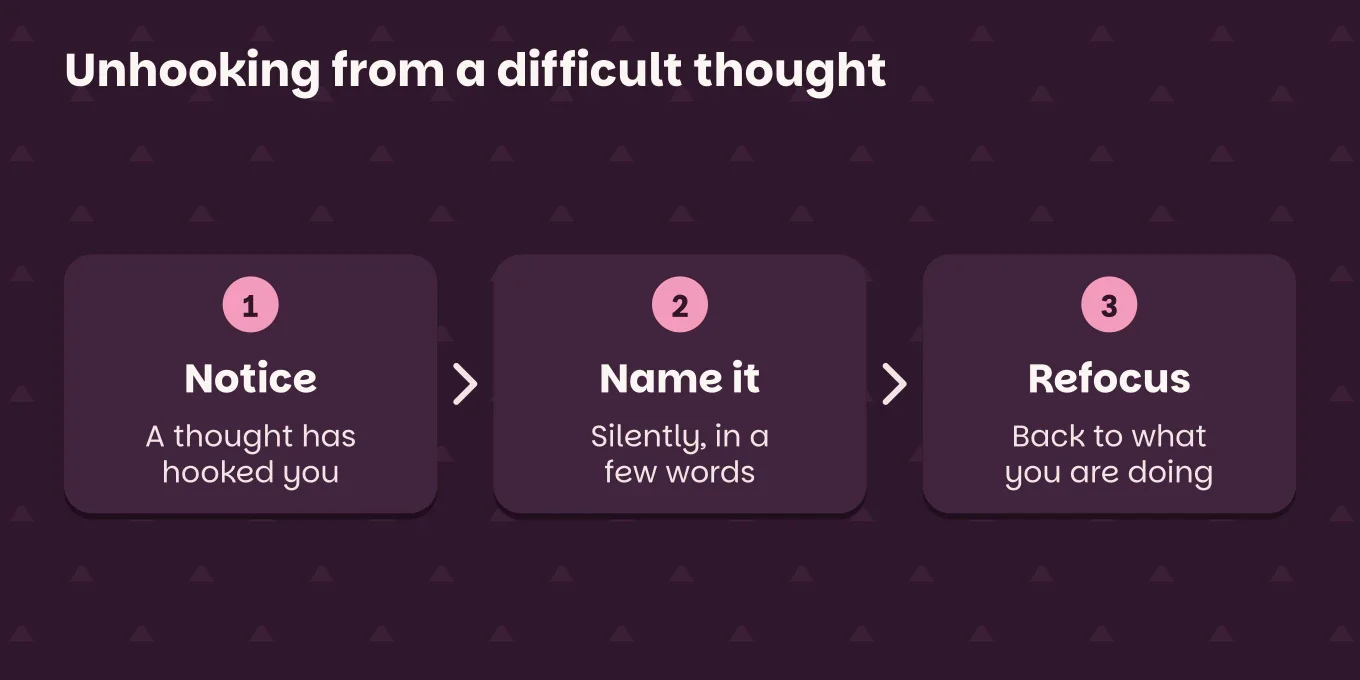
Unhooking is for thoughts that pull you away from what you are doing [7]:
- Notice that a thought or feeling has hooked you.
- Name it silently, for example: "I notice here is anger."
- Refocus on what you are doing, and engage fully with it.
The figure below shows the 3 steps of unhooking: notice that a thought has hooked you; name it silently, in a few words; and refocus, back to what you are doing.
You can also question your thoughts. NIMH suggests that you identify and challenge negative and unhelpful thoughts [3].
Some people find it helps to notice what is going well. The NHS suggests that you write down 3 things that went well, or that you are grateful for, at the end of each day [6]. The CDC also suggests a daily gratitude practice, with specific things written down [2].
Which technique should you start with?
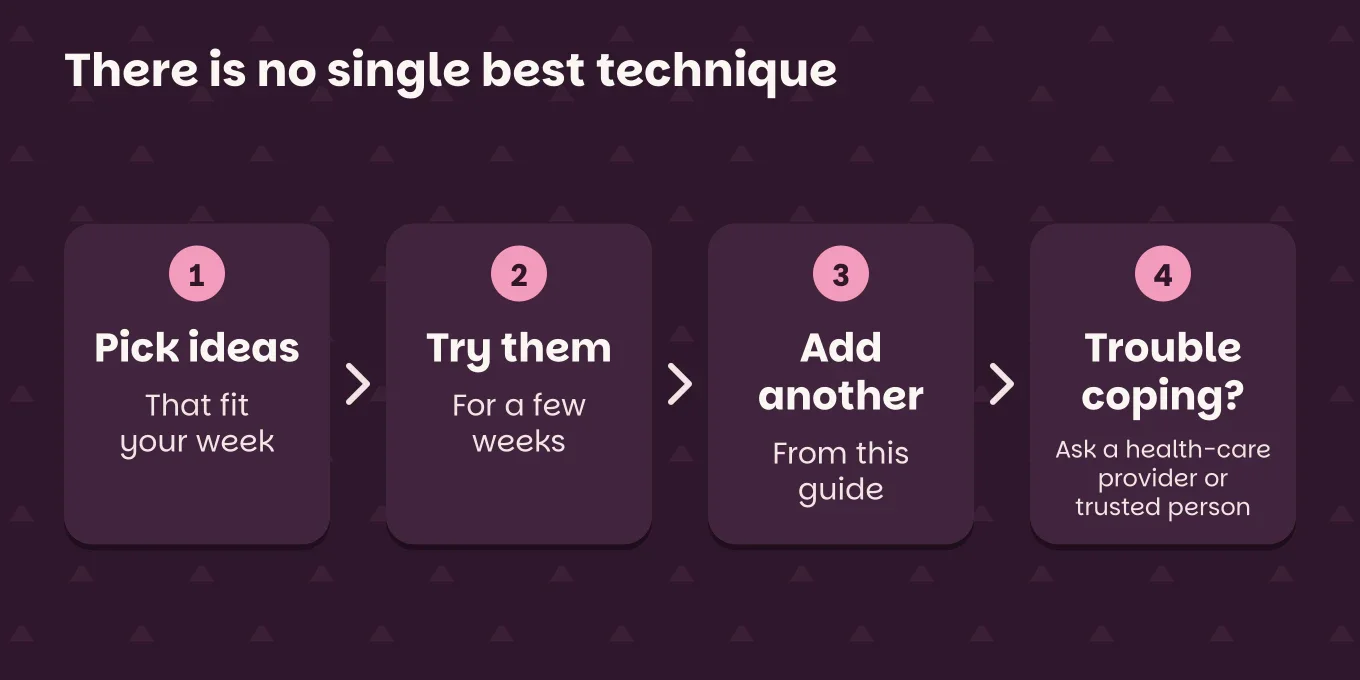
There is no single best technique. NIMH says it may take trial and error to find what works for you [3]. A practical plan is to pick 1 or 2 ideas from this guide that fit your week, try them for a few weeks, and then add another.
Most people manage stress well and carry on with their lives [1]. If you have trouble coping, WHO says to seek help from a trusted health-care provider or another trusted person in your community [1].
The figure below shows this plan: pick ideas that fit your week, try them for a few weeks, add another from this guide, and seek help from a health-care provider or someone you trust if you have trouble coping.
See a doctor if
- You are struggling to cope with stress, or the things you are trying yourself are not helping. The NHS (UK) says to see a GP [4].
- Stress is affecting your daily life. In the UK, the NHS says to contact NHS 111 or talk to a GP [5]; elsewhere, talk to your doctor.
- Stress gets in the way of your everyday life, makes you avoid things, or seems to be there all the time [3].
- You have physical symptoms that worry you. Stress can cause chest pains, but the NHS says these should stop when your stress goes [5]. The NHS also says to see a GP if you have chest pain that comes and goes [9].
- You need help urgently, but it is not an emergency. In the UK, the NHS says to call NHS 111 or ask for an urgent GP appointment; elsewhere, get urgent medical advice [4].
- These chest symptoms are an emergency. In the UK, the NHS says to call 999; elsewhere, call your local emergency number [9]:
- sudden pain or discomfort in your chest that does not go away, which can feel like squeezing or pressure, burning or indigestion
- pain that spreads to your left or right arm, or your neck, jaw, stomach or back
- chest pain with feeling sweaty, sick, light-headed or short of breath
- If you or someone you know needs immediate help, or has seriously harmed themselves, this is an emergency. In the UK, the NHS says to call 999 or go to A&E now; elsewhere, call your local emergency number [4].
If you have thoughts of harming yourself, use the help box at the top of this page now.
How we made this article. We researched it with AI assistance. We then fact-checked every claim against the sources below. Editorial policy
Sources
All sources checked . Found an error? Tell us.
- 1World Health Organization. Stress (opens in a new tab). who.int questions and answers. Published 30 March 2026. Checked 18 October 2026.
- 2Centers for Disease Control and Prevention (US). Managing Stress (opens in a new tab). cdc.gov. Page dated 12 May 2026. Checked 18 October 2026.
- 3National Institute of Mental Health (US). I'm So Stressed Out! Fact Sheet (opens in a new tab). nimh.nih.gov. NIH Publication No. 20-MH-8125, no page date shown. Checked 18 October 2026.
- 4NHS (UK). Stress (opens in a new tab). nhs.uk. Page last reviewed 6 March 2026. Checked 18 October 2026.
- 5NHS Every Mind Matters (UK). Dealing with stress (opens in a new tab). nhs.uk. No review date shown. Checked 18 October 2026.
- 6NHS (UK). 10 stress busters (opens in a new tab). nhs.uk. Page last reviewed 26 June 2026. Checked 18 October 2026.
- 7World Health Organization. Doing What Matters in Times of Stress: An Illustrated Guide (opens in a new tab). who.int. Published 29 April 2020. Checked 18 October 2026.
- 8National Center for Complementary and Integrative Health (US). Relaxation Techniques: What You Need To Know (opens in a new tab). nccih.nih.gov. Last updated June 2021. Checked 18 October 2026.
- 9NHS (UK). Chest pain (opens in a new tab). nhs.uk. Page last reviewed 8 August 2023; the next review was due 8 August 2026. Checked 18 October 2026.