Strength training for beginners: a safe starting guide
Strength training for beginners: how often to train, how hard it should feel, simple home and gym exercises, and how to progress safely.
- Published
- Last checked
Strength training for beginners does not need a gym membership, heavy weights or a complicated plan. It needs a few basic movements, done with good form, a couple of times a week, and a slow, steady way to make them harder.
This guide sets out what the main public health guidelines ask for, how hard each set should feel, which exercises to start with at home or in a gym, and how to progress without getting hurt. It is general guidance for healthy adults, not a plan for an injury or a health condition.
What strength training is
Strength training, also called resistance training or muscle-strengthening activity, is any activity that makes your muscles work harder than usual. You work against a resistance: your own body weight, a band, a dumbbell or a machine [6][9].
It covers more than lifting weights. Between them, the NHS (UK) and the CDC (US) list these examples [4][5]:
- lifting weights
- working with resistance bands
- exercises that use your own body weight, such as push-ups and sit-ups
- heavy gardening, such as digging and shovelling
- carrying heavy shopping bags
- some yoga postures
Regular strength training helps you keep doing everyday tasks, such as getting up from a chair, climbing stairs and carrying groceries. It also slows the loss of muscle and bone that comes with age, and it can lower your chance of a fall [6][9]. The World Health Organization (WHO) says that muscle-strengthening activity brings health benefits on top of those from aerobic activity such as walking or cycling [2].
How much strength training do adults need?
The guidelines agree on the basic amount for adults:
- Worldwide: the WHO recommends muscle-strengthening activities on 2 or more days a week, at moderate or greater intensity, working all the major muscle groups [1][2].
- United States: the CDC recommends muscle-strengthening activity on 2 or more days a week that works all major muscle groups [3].
- United Kingdom: the NHS recommends strengthening activities on at least 2 days a week that work all the major muscle groups [5].
The major muscle groups are your legs, hips, back, abdomen, chest, shoulders and arms [3][5].
Guideline figures in this article: muscle-strengthening on 2 or more days a week and 150 to 300 minutes of moderate aerobic activity a week, from the WHO (worldwide), guidelines published 25 Nov 2020 [1][2]. Muscle-strengthening on 2 or more days a week, from the CDC (United States), "Adult Activity: An Overview", page dated 20 Dec 2023 [3]. 8 to 12 repetitions a set, at least 1 set, and 2 or 3 sets for more benefit, from the CDC (United States), "What Counts as Physical Activity for Adults", page dated 6 Dec 2023 [4]. Strengthening activities on at least 2 days a week, from the NHS (United Kingdom), "Physical activity guidelines for adults aged 19 to 64", page last reviewed 22 May 2024 [5]. 8 to 12 repetitions for each activity, at least 2 sets, and 3 sets for more benefit, from the NHS (United Kingdom), "How to improve your strength and flexibility", page last reviewed 21 Jul 2026 [6]. 5 repetitions of sit-to-stand and 3 sets of 5 to 10 wall press-ups, from the NHS (United Kingdom), "Strength exercises", page last reviewed 28 Feb 2024 [7]. A warm-up of at least 6 minutes, from the NHS (United Kingdom), "How to warm up before exercising", page last reviewed 24 Jun 2026 [8]. At least 2 sessions a week, from the ACSM position stand, published 5 Mar 2026 [10]. We checked these figures on 18 Oct 2026. We recheck guideline figures every 6 months, so our next check is due by 18 Apr 2027.
Strength training is extra to aerobic activity, not instead of it. The WHO recommends 150 to 300 minutes of moderate aerobic activity a week for adults [2]. The NHS (UK) notes that time spent on strength exercises does not count towards your aerobic minutes [6].
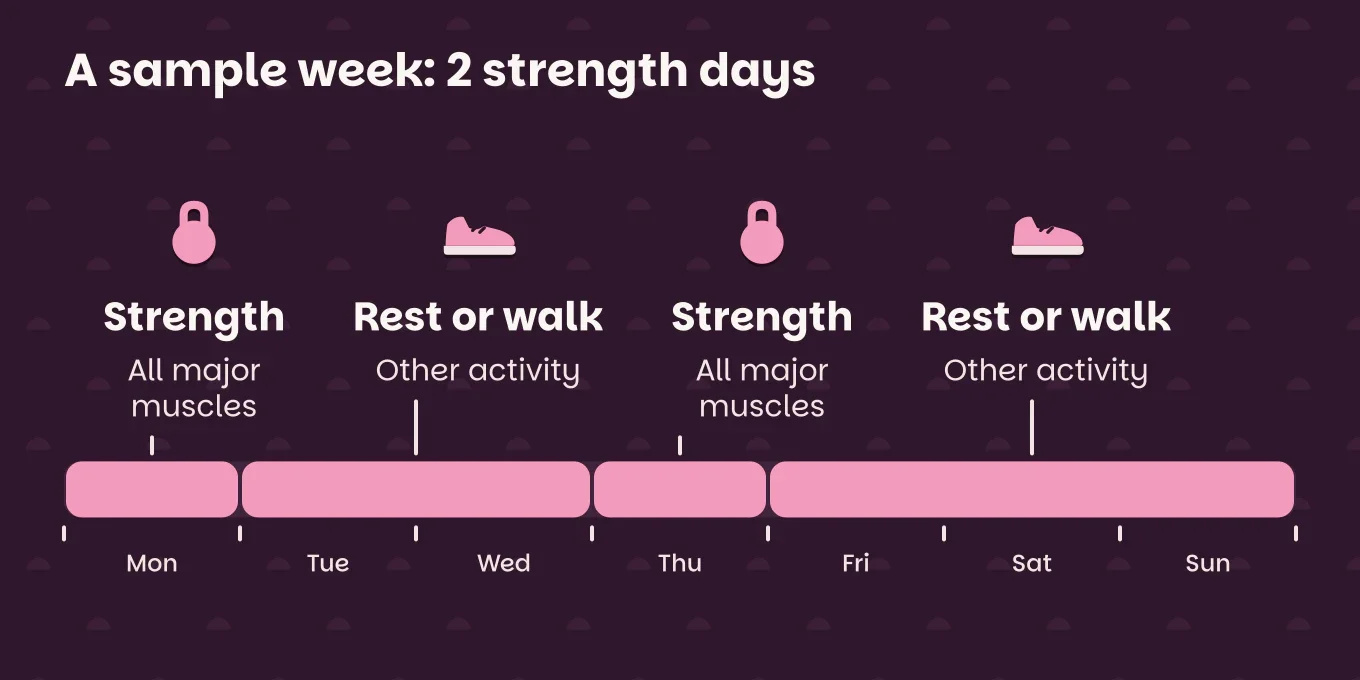
Figure 1 shows 1 way to meet the strength part across a week: a strength session on Monday and another on Thursday, each working all the major muscles, with rest, a walk or other activity on the days between.
For health, you do not need more than this. The WHO review found no evidence that larger amounts of muscle-strengthening activity bring extra health benefits [2]. For a beginner, 2 good sessions a week is a solid target.
Before you start
Speak to a doctor first if you have not exercised for some time, or if you have a medical condition or a concern about your health [5].
If you have a heart condition or another long-term condition, such as diabetes or high blood pressure, ask your doctor which types of activity are safe for you [11]. The WHO also suggests that adults with long-term conditions get advice from a health professional on the type and amount of activity that suits them [2].
For most people, the benefits of regular activity far outweigh the risks to the heart and lungs [11].
How hard should strength training feel?
For a strength exercise to count, it needs to work your muscles until it is hard to do another repetition without help, or until you need a short rest before you carry on [4][5]. A repetition, or rep, is 1 complete movement, such as 1 push-up or 1 lift of a weight [4].
The US and UK guidelines suggest similar numbers, with a small difference in sets:
- United States: the CDC suggests 8 to 12 repetitions per exercise, which counts as 1 set. Do at least 1 set, and 2 or 3 sets for more benefit [4].
- United Kingdom: the NHS suggests 8 to 12 repetitions for each activity, and at least 2 sets, with 3 sets for more benefit [6].
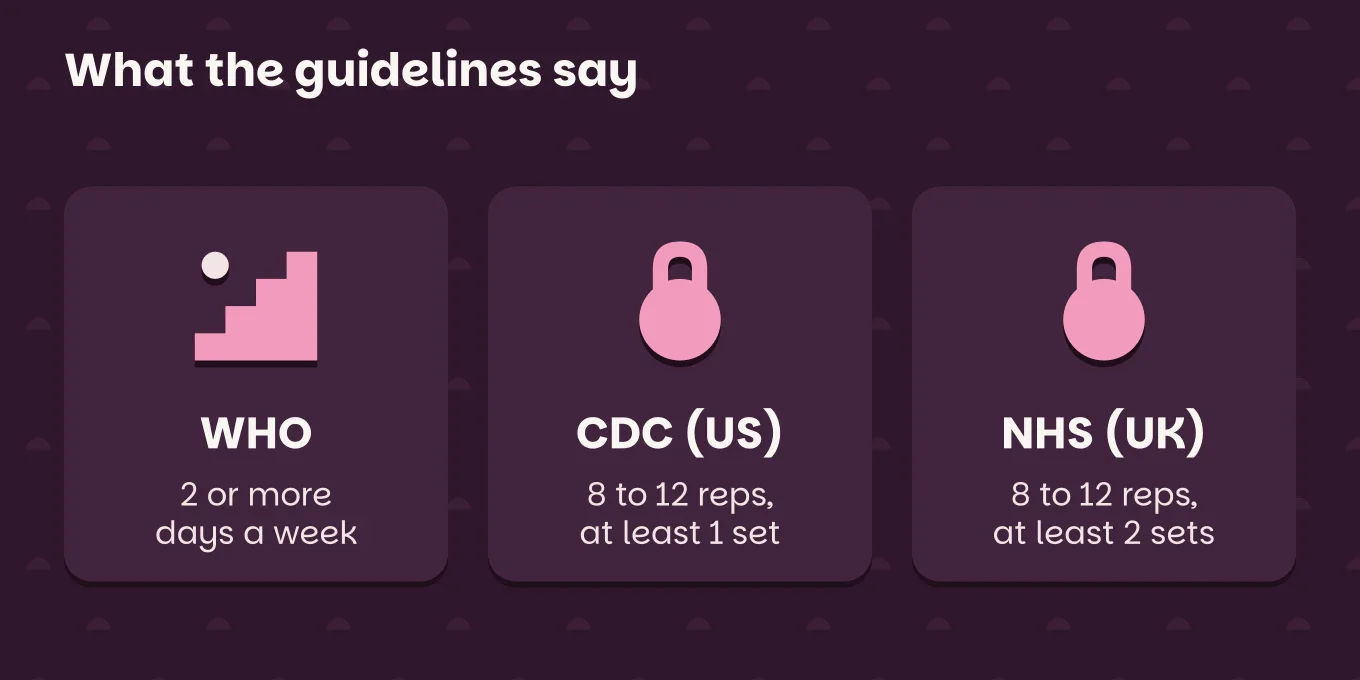
Figure 2 compares the guidelines: the WHO sets 2 or more days a week; the CDC (US) suggests 8 to 12 reps, at least 1 set; and the NHS (UK) suggests 8 to 12 reps, at least 2 sets.
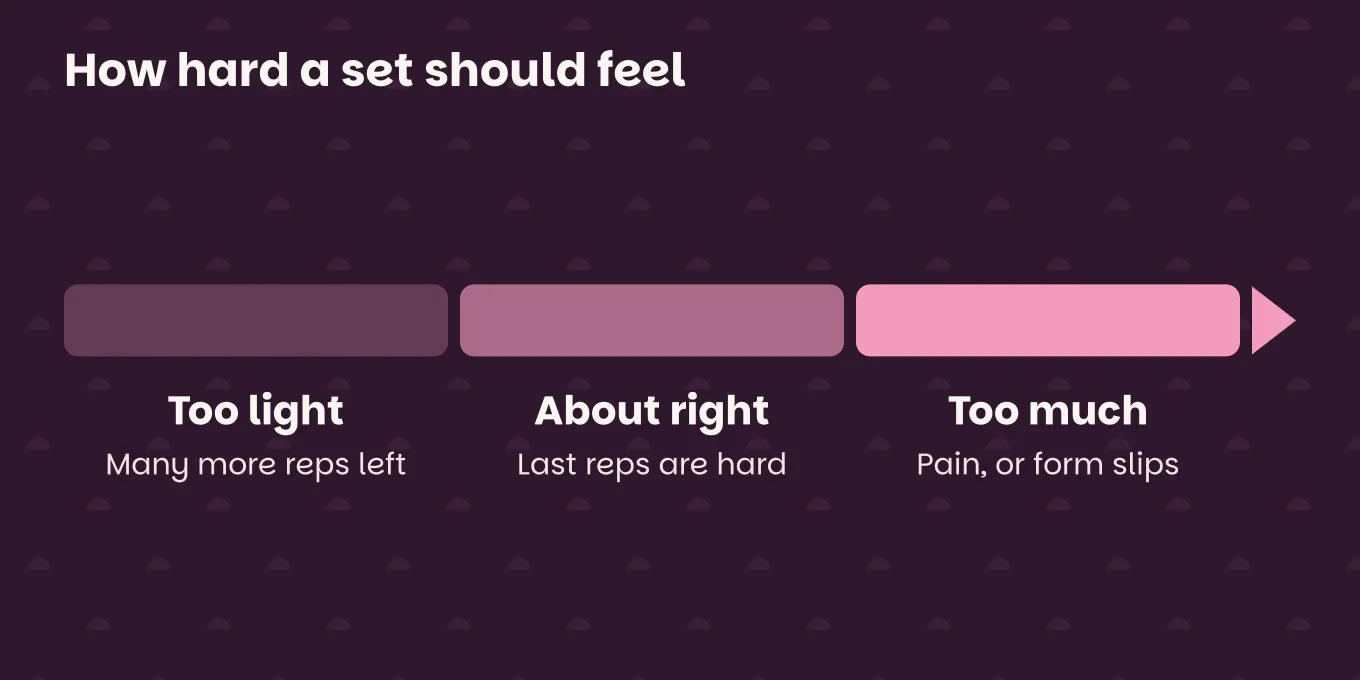
As a beginner, choose an effort level, not a fixed weight. Figure 3 shows the range:
- Too light: you have many more reps left at the end of the set.
- About right: the last reps are hard [4], but your form holds.
- Too much: you feel pain [8][9], or you cannot keep good form.
Warm up first
The NHS suggests a warm-up of at least 6 minutes before you exercise, such as marching on the spot, knee lifts, shoulder rolls and gentle knee bends [8]. For the strength part itself, the US National Institute on Aging (NIA) suggests warming up with the same exercises at a lighter weight [9].
Strength exercises to start with
A simple full-body routine covers your legs, your pushing muscles, your pulling muscles and your core. The American College of Sports Medicine (ACSM) found that strength gains are larger for the exercises you do at the start of a session [10], so begin with the bigger moves, such as squats.
At home
The NHS has a set of gentle strength exercises you can do with a sturdy chair and a wall [7]:
- Sit-to-stand: sit on the edge of a chair, then stand up slowly using your legs, not your arms. Sit down slowly. The NHS suggests 5 repetitions to start, and the slower the better.
- Mini-squats: hold the back of a chair, bend your knees as far as is comfortable, keeping them facing forwards and your back straight, then stand up.
- Calf raises: hold a chair and lift both heels off the floor in a slow, controlled way.
- Wall press-ups: stand at arm's length from a wall, place your hands on it at chest height, bend your arms to bring your chest towards the wall, then push back. The NHS suggests 3 sets of 5 to 10 repetitions.
- Biceps curls: hold a light weight in each hand, such as a filled water bottle, and bend your arms to bring it up to your shoulders, then lower it slowly.
Other bodyweight exercises include squats, lunges, planks and push-ups [9]. A resistance band adds pulling work for your back, for example a seated row with the band around your feet.
In a gym
A gym gives you weight machines, hand-held weights and resistance bands [9]. Machines guide the movement along a fixed path. A beginner session could include:
- a leg press or a squat to a bench, for the legs and hips
- a chest press machine or push-ups, for the chest, shoulders and arms
- a seated row or a lat pulldown machine, for the back
- a plank, for the abdomen
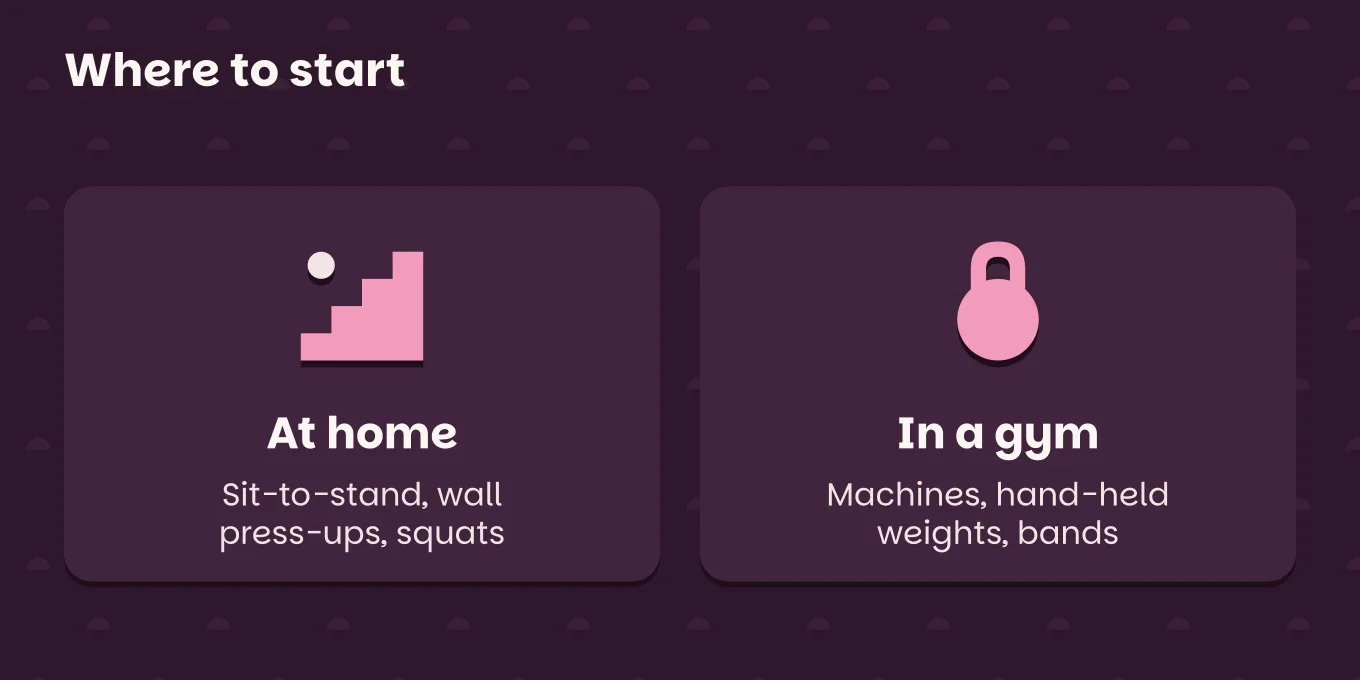
Figure 4 sets the 2 options side by side. At home: sit-to-stand, wall press-ups and squats. In a gym: machines, hand-held weights and bands.
How to keep good form
Good form means you control the weight through the whole movement, instead of letting it control you. These points help:
- Learn the movement first. If you are a beginner, try exercises without weights or bands until you are comfortable with the movement [9].
- Move slowly and with control. The NHS strength exercises ask you to move slowly. For sit-to-stand, it says the slower the repetitions, the better [7].
- Keep breathing. Do not hold your breath. Breathe out during the effort and breathe in as you relax [9].
- Do not lock your joints. Avoid locking your arms and legs straight at the end of a movement [9].
- Get help with technique. A session or 2 with a personal trainer, a group class, or a video of the exercise can help you learn good form [9].
- Stop if it hurts. Stop the exercise straight away if you feel pain or become unwell [8].
How to progress safely
The WHO advises people who are starting out to begin with small amounts of activity and increase them gradually over time [2]. Muscles get stronger when you slowly add weight, sets, repetitions or days of exercise [9].
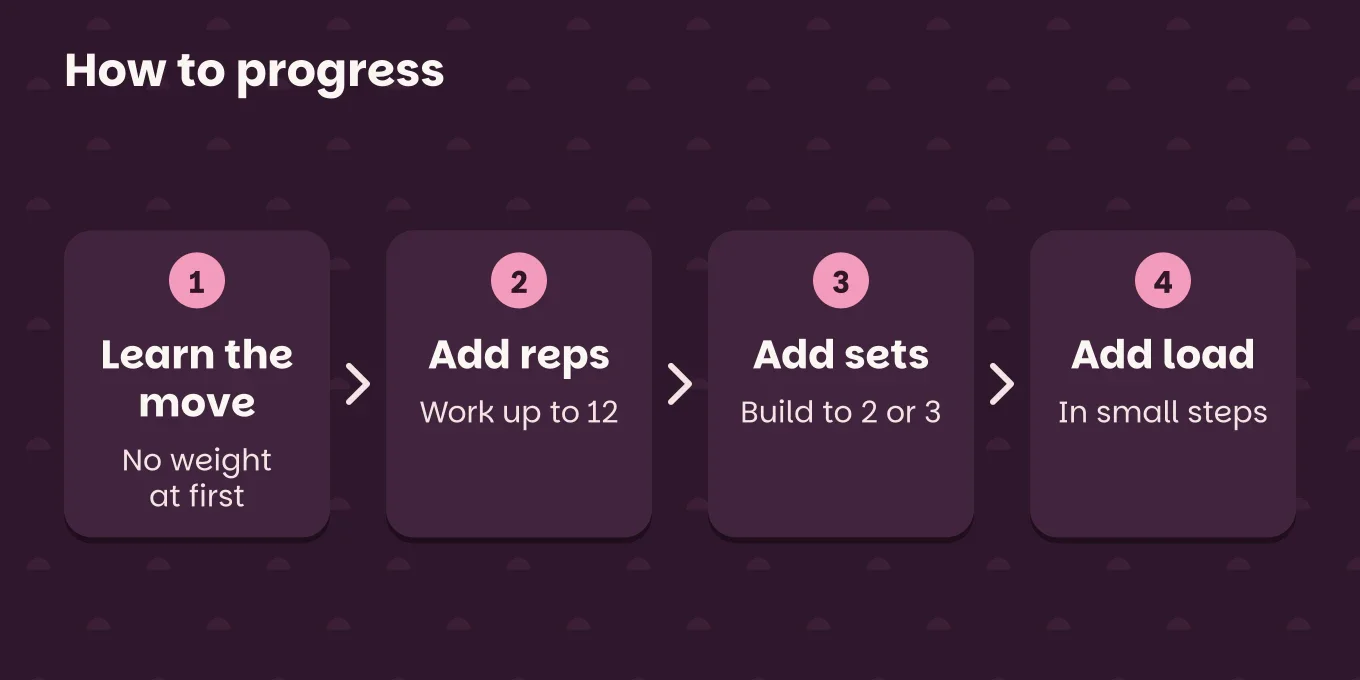
Change 1 thing at a time, in this order:
- Learn the move. Start with no weight, or the easiest version of the exercise [9].
- Add reps. Work up to 12 repetitions with good form [4].
- Add sets. Then build up to 2 or 3 sets [4][6].
- Add load. Then make the exercise harder: a heavier weight, a stronger band, or a harder version of the move.
Make each increase small and gradual [2][9]. Drop back to the lower end of your rep range at the new weight, then build up again.
Figure 5 shows these 4 steps: learn the move with no weight at first; add reps up to 12; add sets up to 2 or 3; then add load in small steps.
For a bodyweight exercise, a harder version does the same job as more weight. A wall press-up, for example, gets harder as you move your hands to a lower, sturdy surface, such as a kitchen counter, and then to the floor.
Rest days and recovery
Your muscles need time to recover between sessions. The NIA advises that you avoid working the same muscle group on 2 days in a row [9]. ACSM's 2026 position stand found that strength improves more with at least 2 sessions a week [10]. A full-body session on 2 or 3 days, with at least 1 rest day between, meets both points.
A rest day does not have to be a still day. Walking, cycling or other aerobic activity count towards your weekly aerobic target [2].
Watch for signs that you are doing too much. Overdoing strength exercises can cause exhaustion, sore joints, and muscle pain or injury [9]. If you notice these, ease back on the weight or the number of sets, and add a rest day. If pain does not settle, see the list below.
See a doctor if
- You have chest pain or dizziness during physical activity. Stop exercising and talk to your doctor [11].
- You have joint pain that has not improved after 2 weeks, keeps coming back, or stops you from doing normal activities or sleeping [12].
- You have very bad joint pain after a fall or injury, a joint that looks out of place, you cannot walk or put weight on a joint, or you have tingling or no feeling in the area around the joint after an injury. In the UK, the NHS says to go to A&E or call 999 [12]; elsewhere, call your local emergency number.
- You have a heart condition or another long-term condition and have not yet asked your doctor which activities are safe for you [11].
- These are an emergency. Stop exercising. In the UK, the NHS says to call 999 [13]; elsewhere, call your local emergency number:
- sudden pain or discomfort in your chest that does not go away, which can feel like squeezing or pressure inside your chest, burning or indigestion
- pain that spreads to your left or right arm, or your neck, jaw, stomach or back
- chest pain with sweating, feeling sick, light-headed or short of breath
How we made this article. We researched it with AI assistance. We then fact-checked every claim against the sources below. Editorial policy
Sources
All sources checked . Found an error? Tell us.
- 1World Health Organization. WHO guidelines on physical activity and sedentary behaviour. who.int. Published 25 November 2020. Checked 18 October 2026.
- 2Bull FC, Al-Ansari SS, Biddle S, et al. World Health Organization 2020 guidelines on physical activity and sedentary behaviour. British Journal of Sports Medicine, volume 54, pages 1451 to 1462. Published December 2020. Checked 18 October 2026.
- 3Centers for Disease Control and Prevention (US). Adult Activity: An Overview. cdc.gov. Page dated 20 December 2023. Checked 18 October 2026.
- 4Centers for Disease Control and Prevention (US). What Counts as Physical Activity for Adults. cdc.gov. Page dated 6 December 2023. Checked 18 October 2026.
- 5NHS (UK). Physical activity guidelines for adults aged 19 to 64. nhs.uk. Page last reviewed 22 May 2024. Checked 18 October 2026.
- 6NHS (UK). How to improve your strength and flexibility. nhs.uk. Page last reviewed 21 July 2026. Checked 18 October 2026.
- 7NHS (UK). Strength exercises. nhs.uk. Page last reviewed 28 February 2024. Checked 18 October 2026.
- 8NHS (UK). How to warm up before exercising. nhs.uk. Page last reviewed 24 June 2026. Checked 18 October 2026.
- 9National Institute on Aging (US). Three Types of Exercise Can Improve Your Health and Physical Ability. nia.nih.gov. Content reviewed 14 January 2025. Checked 18 October 2026.
- 10Currier BS, D'Souza AC, Singh MAF, et al. American College of Sports Medicine Position Stand. Resistance Training Prescription for Muscle Function, Hypertrophy, and Physical Performance in Healthy Adults: An Overview of Reviews. Medicine and Science in Sports and Exercise, volume 58, pages 851 to 872. Published 5 March 2026. Checked 18 October 2026.
- 11National Heart, Lung, and Blood Institute (US). Physical Activity and Your Heart: Risks. nhlbi.nih.gov. Last updated 24 March 2022. Checked 18 October 2026.
- 12NHS (UK). Joint pain. nhs.uk. Page last reviewed 26 February 2026. Checked 18 October 2026.
- 13NHS (UK). Chest pain. nhs.uk. Page last reviewed 8 August 2023. Checked 18 October 2026.