How to fall asleep fast: habits with evidence behind them
Evidence-based ways for adults to fall asleep faster, from a steady wake time and evening light to caffeine timing and what to do after 20 minutes awake.
- Published
- Last checked
There is no switch that puts you to sleep on demand. What you can do is remove the things that keep you awake and give your body clear signals that night has come. The habits below come from national health services, sleep medicine bodies and controlled studies. Some can help tonight. Others are habits that pay off over weeks.
This guide is for adults. It covers habits only, not sleep medicines or supplements.
The short answer
If you want the quick version, these are the steps that national guides agree on most:
- Get up at the same time every day, weekends included [1, 2].
- Give yourself about 1 hour to wind down before bed [3].
- Keep screens and bright light out of that last hour [4, 2].
- Stop caffeine at least 6 hours before bed [3, 5].
- Do not use alcohol as a sleep aid. It can make you drowsy, but it disturbs sleep later in the night [6].
- If you are still awake after about 20 minutes, get up, sit somewhere comfortable, and go back to bed when you feel sleepy [4, 1].
The rest of this article explains each step and why it helps.
Guideline figures in this article: sleep hours by age and turning off electronic devices at least 30 minutes before bed, from the CDC (United States), "About sleep", published 15 May 2024 [7]. Wind down for at least 1 hour, no tea or coffee for at least 6 hours, no exercise for at least 4 hours before bed, and no alcohol for at least 6 hours before bed, from the NHS (United Kingdom), "Insomnia", page last reviewed 19 Mar 2024 [3]. No screens for an hour before bed, alcohol avoided 1 to 2 hours before bed, and getting up after around 20 minutes awake, from NHS Every Mind Matters (United Kingdom), page updated 15 Sep 2026 [4]. Screens off at least 30 minutes before bed and getting up after 20 minutes awake, from the American Academy of Sleep Medicine (United States), "Healthy sleep habits", updated Aug 2020 [1]. Caffeine effects lasting up to 8 hours, weekday and weekend schedules within about an hour, no intense exercise in the hour before bed, and naps of no more than 20 minutes, from the NHLBI (United States), "Healthy sleep habits", last updated 24 Mar 2022 [2]. We checked these figures on 18 Oct 2026. We recheck guideline figures every 6 months, so our next check is due by 18 Apr 2027.
Why trying harder does not work
Sleep is not something you can do on purpose, the way you can walk or read. The NHS advises you not to force it [4]. Lying in bed and straining to sleep can keep you alert, and the bed can start to feel like a place for lying awake [16].
That is why many of the steps here are about what you do before bed, and about leaving the bed when sleep does not come. The goal is to make falling asleep the easy, expected thing your body does when you lie down.
Keep the same wake time every day
A steady schedule is the habit that appears in almost every guide. The American Academy of Sleep Medicine (AASM) advises you to get up at the same time every day, even on weekends and holidays [1]. The US National Heart, Lung, and Blood Institute (NHLBI) suggests that you keep the difference between weeknights and weekends to no more than about an hour [2].
Start with your wake time. You cannot choose the minute you fall asleep, but you can choose when your alarm goes off.
These tips help the schedule hold:
- Go to bed only when you feel sleepy [1, 3].
- After a bad night, do not sleep in. Keep your usual hours instead [3].
How much sleep should the schedule allow? The US Centers for Disease Control and Prevention (CDC) gives these figures for adults [7]:
Guideline figure: adults aged 18 to 60 need 7 or more hours of sleep a night, adults aged 61 to 64 need 7 to 9 hours, and adults aged 65 and older need 7 to 8 hours. Source: CDC (United States), "About sleep", published 15 May 2024 [7]. We checked this figure on 18 Oct 2026. We recheck guideline figures every 6 months, so our next check is due by 18 Apr 2027.
Set your bedtime so that it leaves room for this much sleep before your fixed wake time.
Give yourself an hour to wind down
Your brain needs time to shift from the day to the night. The NHS suggests that you relax for at least 1 hour before bed, for example with a bath or a book [3]. The NHLBI also suggests that you use the hour before bed for quiet time [2].
A wind-down routine does not need to be long or special. It needs to be calm and roughly the same each night, so that it becomes a cue. Ideas from the NHS include reading something you enjoy, meditation, breathing exercises, calming music or a podcast [4].
If worries keep you awake, try writing them down. The NHS suggests that you write a list of things you need to do the next day before you go to sleep [4]. In a sleep lab study of 57 young adults, people who spent 5 minutes writing a to-do list fell asleep faster than people who listed tasks they had already finished. The more specific the to-do list, the faster people fell asleep [8]. It was a single small study, but the habit costs nothing to try.
Use light on your side
Light is the strongest signal for your body clock. The master clock in your brain sets the release of melatonin, the hormone that makes you sleepy, based on how much light your eyes receive [9]. Bright light in the evening may signal your brain that it is time to be awake [2].
Screens are a common source of evening light. In a controlled study, adults who read on a light-emitting e-reader before bed took longer to fall asleep than when they read a printed book. They also released less melatonin, their body clock shifted later, and they were less alert the next morning [10].
Practical steps:
- Put phones, tablets and computers away for an hour before bed [4]. If that feels like too much, the AASM and the CDC suggest at least 30 minutes [1, 7].
- Keep the lights low in the evening [1].
- Spend time outside every day when you can [2]. Daylight helps keep your body clock in step with day and night [9].
- Make your bedroom dark. Curtains, blinds or an eye mask can help [3].
Time caffeine, alcohol and meals
Caffeine
Caffeine keeps you alert for longer than most people think. The NHLBI says its effects can last up to 8 hours [2]. The NHS advises no tea or coffee for at least 6 hours before bed [3], and the CDC suggests that you skip caffeine in the afternoon and evening [7].
A small study points the same way. Researchers gave 12 healthy adults a 400 mg dose of caffeine, which they described as moderate, at bedtime, 3 hours before bedtime or 6 hours before bedtime. All 3 timings disturbed sleep compared with a placebo. A sleep monitor worn at home showed that even the 6-hour dose cut total sleep time by more than 1 hour [5].
Remember that caffeine is also in some soft drinks and in chocolate [4, 2].
Alcohol
Alcohol can make you fall asleep faster, which is why some people use it as a nightcap. A review of studies in healthy adults found that the cost comes later: sleep later in the night is more disturbed [6]. Health guides agree on keeping alcohol away from bedtime [7, 1]. The NHS advice ranges from 1 to 2 hours before bed on its sleep tips page [4] to at least 6 hours on its insomnia page [3]. The stricter figure comes from the page written for people with insomnia. If alcohol is part of your evening, earlier is better than later.
Meals
Large meals close to bedtime can make it harder to fall asleep [4]. The NHLBI suggests that you avoid heavy meals within a few hours of bedtime, and says that a light snack is fine [2].
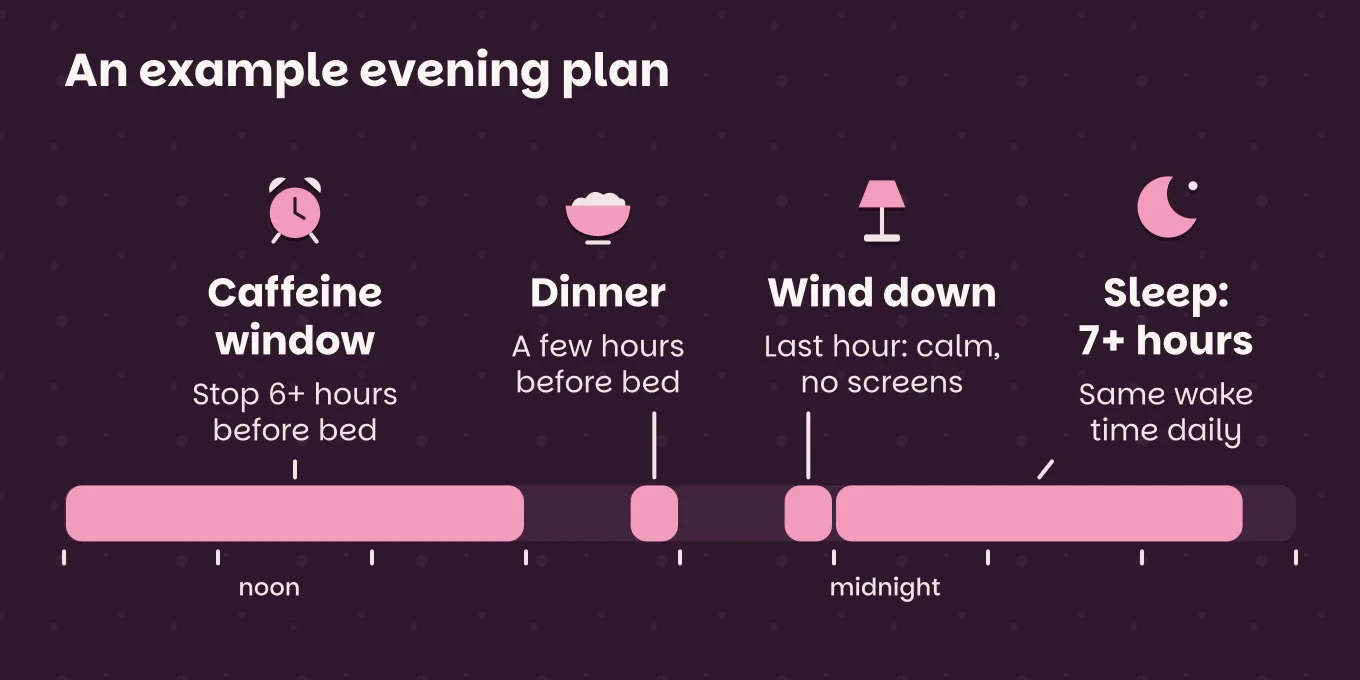
Fig. 1 shows how these timings fit together, with an 11 pm bedtime as an example. The caffeine window closes 6 or more hours before bed [3]. Dinner comes a few hours before bed [2]. The last hour is for winding down: calm, with no screens [3]. The night leaves room for 7 or more hours of sleep [7], with the same wake time every day [1].
Make your bedroom a place for sleep
Guides from the UK and the US describe the same room: quiet, dark and cool [4, 2, 7]. Earplugs, a silenced phone and curtains that close fully all help [4]. A dim night light is fine if you need one [2].
Some less obvious tips:
- Keep clocks out of view. The NHS suggests this [4].
- Use your bed for sleep and sex only. The AASM recommends this [1]. That means no work, scrolling or TV in bed.
Your mattress, pillows and covers should be comfortable too [3].
If you are still awake after about 20 minutes
This is the step people find hardest, because it feels like giving up. The NHS says that if you are still awake after around 20 minutes, get up and sit somewhere comfortable, then go back to bed when you feel sleepy [4]. The AASM gives the same advice and adds that the quiet activity should not involve a lot of light or electronics [1].
Both the NHS and the AASM give this advice to everyone, not only to people with a sleep problem [4, 1]. The aim is for getting into bed to feel relaxing again, not frustrating [16].
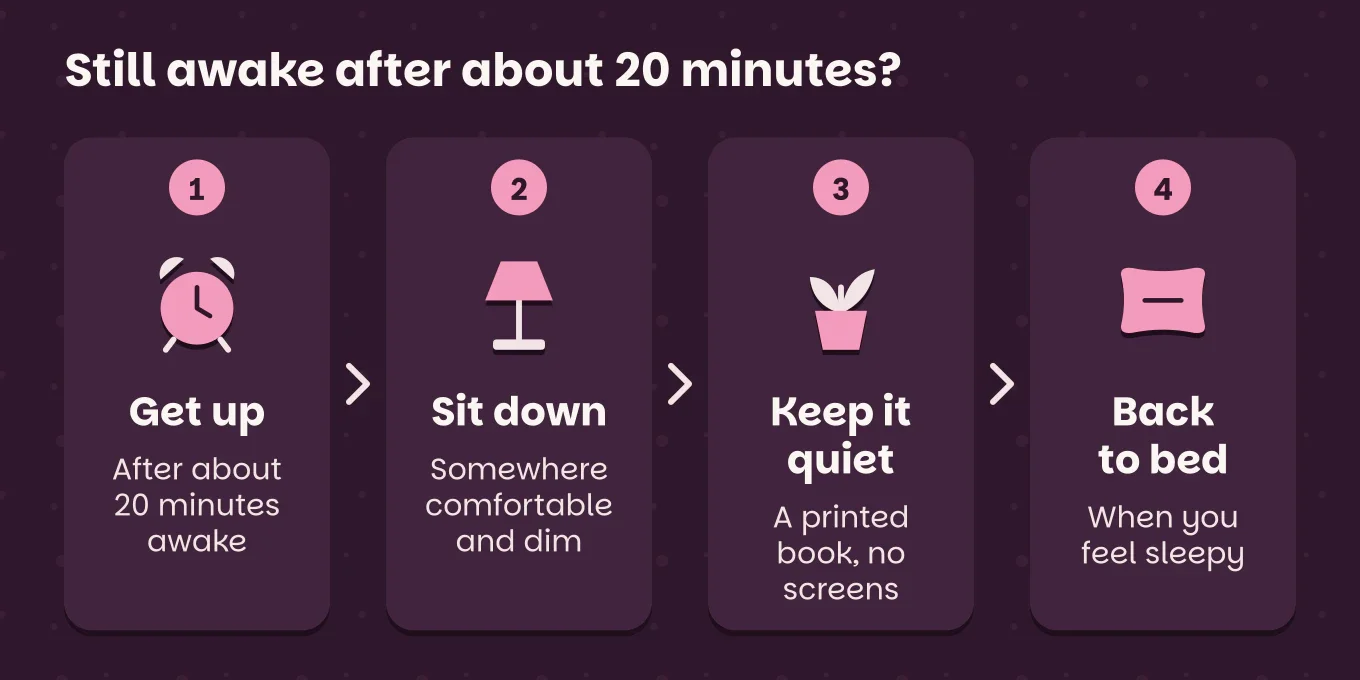
Fig. 2 shows the steps:
- Get up if you are still awake after about 20 minutes [4].
- Sit down somewhere comfortable and dim [4, 1].
- Keep it quiet. Read a printed book, for example, and use no screens [1].
- Go back to bed when you feel sleepy [4].
You do not need to time this exactly. The NHS says "around" 20 minutes [4], and the AASM page on CBT says "about" 20 minutes [16], so you do not need to check the time. Keep clocks out of view [4].
Relaxation methods to try in bed
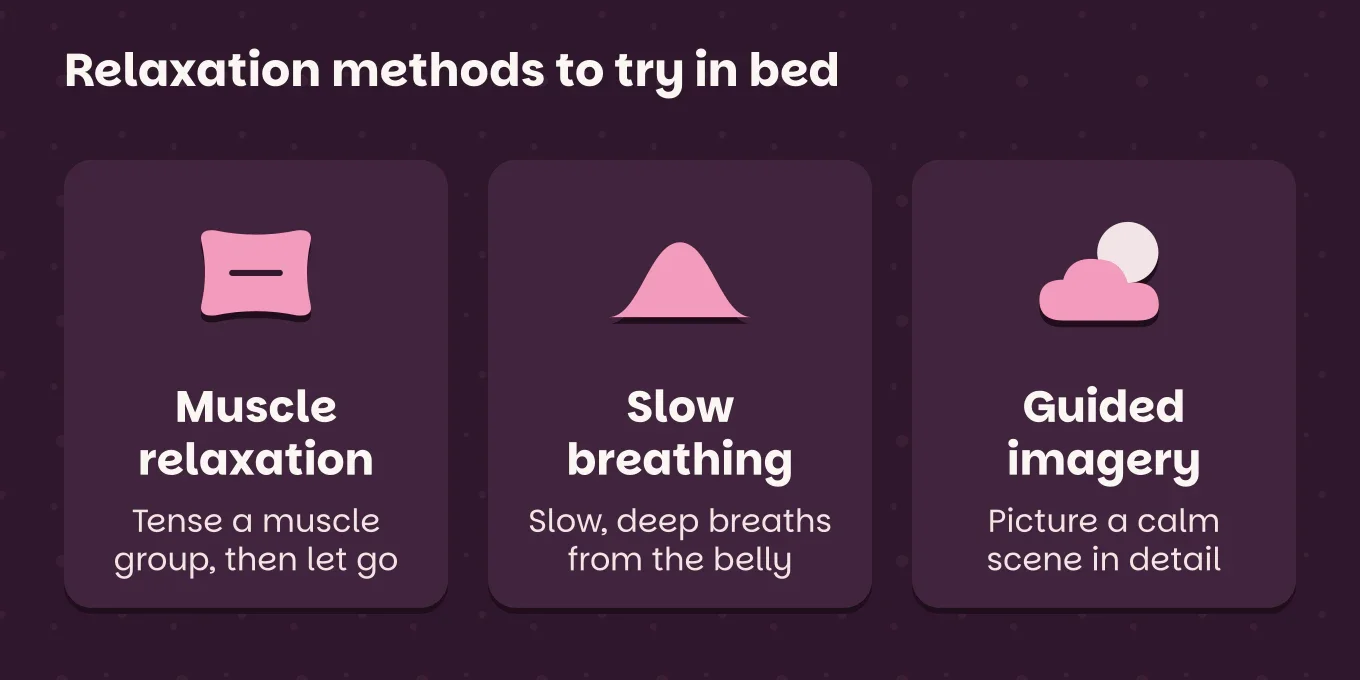
Relaxation techniques give your mind something calm to do instead of worrying. The US National Center for Complementary and Integrative Health (NCCIH) describes several [12]:
- Progressive muscle relaxation. Tense a group of muscles, then let it go. Work slowly from your feet up to your face.
- Slow breathing. Breathe slowly and deeply from your belly. This is also called diaphragmatic breathing.
- Guided imagery. Picture a calm scene in detail: what you would see, hear and feel there.
Fig. 3 compares these 3 methods.
Be realistic about what to expect. The NCCIH notes that relaxation techniques can be part of cognitive behavioural therapy for insomnia, but do not seem especially promising on their own [12]. Treat them as a helpful part of a routine, not a guaranteed off switch.
You may have seen "4-7-8 breathing" online. It involves holding your breath. Stop and breathe normally if you feel dizzy, light-headed or unwell. If you have a heart or lung condition, or are pregnant, ask a doctor before trying breath-hold exercises. The pattern uses a count of 4 to breathe in, 7 to hold and 8 to breathe out [18].
A few small studies have tested 4-7-8 breathing, for example in healthy young adults [18] and in people with tinnitus [17]. In a 2026 trial, 48 adults with tinnitus had either an information session alone or the session plus 6 weeks of 4-7-8 breathing. The breathing group's insomnia scores fell compared with the session-only group [17]. That was a small trial in people with a specific condition, so it does not show that 4-7-8 breathing helps everyone fall asleep. None of the health guides cited here names the method.
Relaxation techniques are generally safe for healthy people. A few people feel more anxious when they try them [12]. If that happens, you can stop.
Daytime habits that help at night
What you do during the day shapes how ready you are for sleep.
- Be active, earlier in the day. Health guides advise regular exercise [3, 7]. The NHS advises no exercise in the 4 hours before bed [3]. The NHLBI advises against intense exercise in the hour before bed [2]. If late workouts keep you awake, move them earlier [4].
- Keep naps short, or skip them. The NHLBI says adults should nap for no more than 20 minutes. If you struggle to fall asleep at night, limit naps or take them earlier in the afternoon [2]. The NHS insomnia page advises no daytime naps at all [3].
- Avoid nicotine near bedtime. Like caffeine, it is a stimulant [2].
- Do not drive when you feel sleepy. The NHS gives this advice to people who sleep badly [3].
When it is more than a bad night
Many people have bad nights after stress, travel or a change in routine. These often pass in a few days to a few weeks [13].
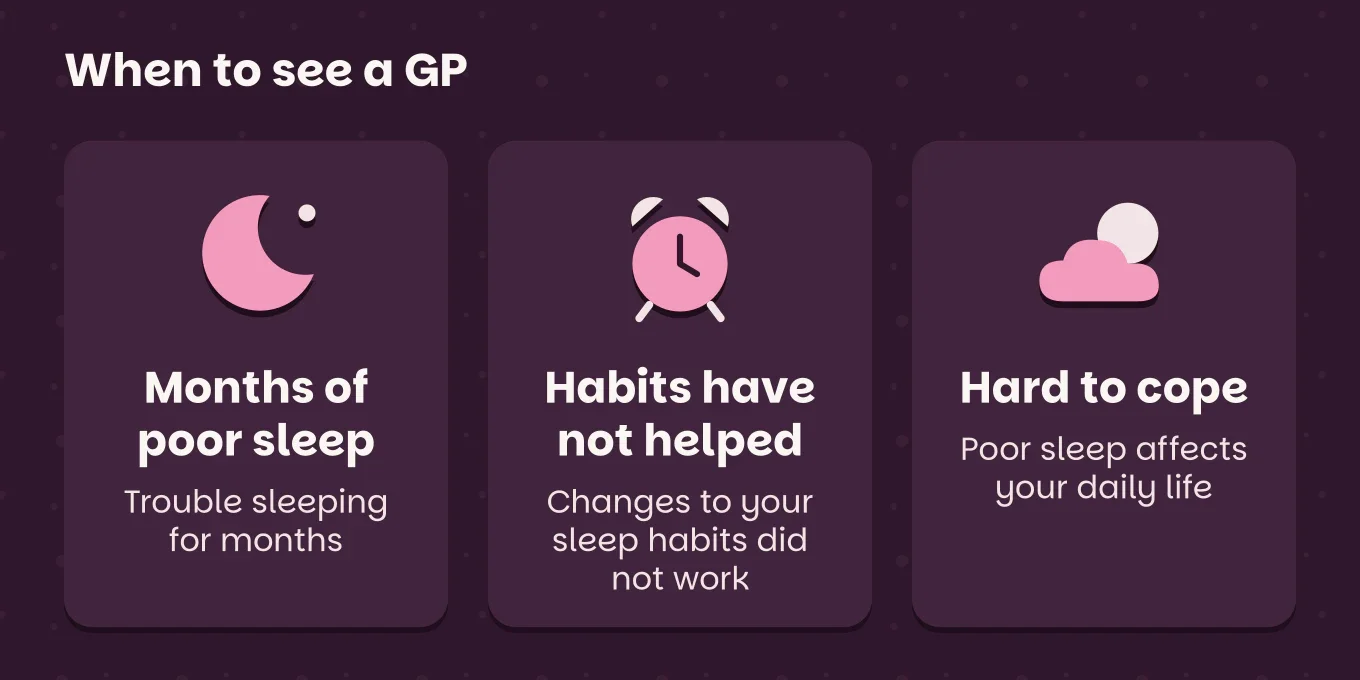
See a GP if you have had trouble sleeping for months [3], or on 3 or more nights a week for more than 3 months [13]. You do not need to wait that long. See a GP at any time if poor sleep makes daily life hard to cope with, or if changing your habits has not helped [3].
Fig. 4 shows these 3 reasons to see a GP: months of poor sleep, habits that have not helped, and poor sleep that makes daily life hard to cope with [3].
A doctor may suggest cognitive behavioural therapy for insomnia (CBT-I), face to face or through an online programme [3]. It helps you change the thoughts and behaviours that keep you from sleeping [3], and a US sleep medicine guideline recommends it for adults with long-term insomnia [11].
Some sleep problems are not insomnia at all. Sleep apnoea is a condition in which your breathing stops and starts while you sleep. Signs include loud snoring, gasping or choking noises, and feeling very tired during the day [14, 15]. It needs a doctor's assessment, which may include a sleep study [15].
See a doctor if
- You have had trouble sleeping for months [3], or on 3 or more nights a week for more than 3 months [13].
- Changing your sleep habits has not helped [3].
- Poor sleep makes it hard to cope with daily life [3].
- You snore loudly most nights, or someone sees your breathing stop and start while you sleep [14, 15].
- You make gasping, snorting or choking noises in your sleep [14].
- You always feel very tired during the day [14].
- You think a medicine you take may be affecting your sleep. Many medicines can cause insomnia [3].
How we made this article. We researched it with AI assistance. We then fact-checked every claim against the sources below. Editorial policy
Sources
All sources checked . Found an error? Tell us.
- 1American Academy of Sleep Medicine (United States). Healthy sleep habits. sleepeducation.org. Updated Aug 2020. Checked 18 Oct 2026.
- 2National Heart, Lung, and Blood Institute, NIH (United States). Sleep deprivation and deficiency: healthy sleep habits. nhlbi.nih.gov. Last updated 24 Mar 2022. Checked 18 Oct 2026.
- 3NHS (United Kingdom). Insomnia. nhs.uk. Page last reviewed 19 Mar 2024. Checked 18 Oct 2026.
- 4NHS Every Mind Matters (United Kingdom). How to fall asleep faster and sleep better. nhs.uk. Page updated 15 Sep 2026 (page metadata). Checked 18 Oct 2026.
- 5Drake C, Roehrs T, Shambroom J, Roth T. Caffeine effects on sleep taken 0, 3, or 6 hours before going to bed. Journal of Clinical Sleep Medicine. 2013;9(11):1195-1200. Checked 18 Oct 2026.
- 6Ebrahim IO, Shapiro CM, Williams AJ, Fenwick PB. Alcohol and sleep I: effects on normal sleep. Alcoholism: Clinical and Experimental Research. 2013;37(4):539-549. Checked 18 Oct 2026.
- 7Centers for Disease Control and Prevention (United States). About sleep. cdc.gov. Published 15 May 2024. Checked 18 Oct 2026.
- 8Scullin MK, Krueger ML, Ballard HK, Pruett N, Bliwise DL. The effects of bedtime writing on difficulty falling asleep: a polysomnographic study comparing to-do lists and completed activity lists. Journal of Experimental Psychology: General. 2018;147(1):139-146. Checked 18 Oct 2026.
- 9National Institute of General Medical Sciences, NIH (United States). Circadian rhythms. nigms.nih.gov. Content reviewed Sep 2023. Checked 18 Oct 2026.
- 10Chang AM, Aeschbach D, Duffy JF, Czeisler CA. Evening use of light-emitting eReaders negatively affects sleep, circadian timing, and next-morning alertness. Proceedings of the National Academy of Sciences. 2015;112(4):1232-1237. Checked 18 Oct 2026.
- 11Edinger JD, Arnedt JT, Bertisch SM, et al. Behavioral and psychological treatments for chronic insomnia disorder in adults: an American Academy of Sleep Medicine clinical practice guideline. Journal of Clinical Sleep Medicine. 2021;17(2):255-262. Checked 18 Oct 2026.
- 12National Center for Complementary and Integrative Health, NIH (United States). Relaxation techniques: what you need to know. nccih.nih.gov. Last updated Jun 2021. Checked 18 Oct 2026.
- 13National Heart, Lung, and Blood Institute, NIH (United States). Insomnia: what is insomnia?. nhlbi.nih.gov. Last updated 24 Mar 2022. Checked 18 Oct 2026.
- 14NHS (United Kingdom). Sleep apnoea. nhs.uk. Page last reviewed 11 May 2026. Checked 18 Oct 2026.
- 15National Heart, Lung, and Blood Institute, NIH (United States). Sleep apnea: symptoms. nhlbi.nih.gov. Last updated 9 Jan 2025. Checked 18 Oct 2026.
- 16American Academy of Sleep Medicine (United States). Cognitive behavioral therapy. sleepeducation.org. Updated Oct 2020. Checked 18 Oct 2026.
- 17Kirazli G, Baran S, Uysal GS, Ozdogan A, Durankaya SM, Ogut MF. The effect of 4-7-8 breathing exercise technique on tinnitus handicap, psychological factors, and sleep quality in tinnitus patients: a randomized controlled study. Brain and Behavior. 2026;16(2):e70854. Checked 18 Oct 2026.
- 18Vierra J, Boonla O, Prasertsri P. Effects of sleep deprivation and 4-7-8 breathing control on heart rate variability, blood pressure, blood glucose, and endothelial function in healthy young adults. Physiological Reports. 2022;10(13):e15389. Checked 18 Oct 2026.