High-fiber foods: a sourced list and daily guidance
High-fibre foods by group, with measured fibre per 100 g from USDA data, plus what WHO, the UK, Canada and the US say about daily fibre.
- Published
- Last checked

Fibre is a substance found in plant foods [1]. Beans, whole grains, vegetables, fruit, nuts and seeds all contain it, but in very different amounts. This guide lists high-fibre foods in each group, with their measured fibre content. It also sets out what WHO, the UK, Canada and the US say about how much fibre adults should eat.
Fibre is spelled "fiber" in the US. This guide uses "fibre". It gives general guidance for healthy adults. It is not advice for any digestive condition.
What fibre is
The fibre you eat, called dietary fibre, is found in fruits, vegetables and grains [1].
Health Canada's nutrient reference tables use 3 terms that you may see on labels and in articles [2]:
- Dietary fibre: non-digestible carbohydrates and lignin that are intrinsic and intact in plants. In plain words, the fibre that is naturally part of a plant food.
- Functional fibre: isolated non-digestible carbohydrates that have been shown to have beneficial physiological effects in humans.
- Total fibre: the sum of dietary fibre and functional fibre.
This guide is about dietary fibre from whole foods. WHO frames its advice the same way: its figure is for naturally occurring dietary fibre as found in foods [3].
You may also see fibre described as soluble or insoluble [1]:
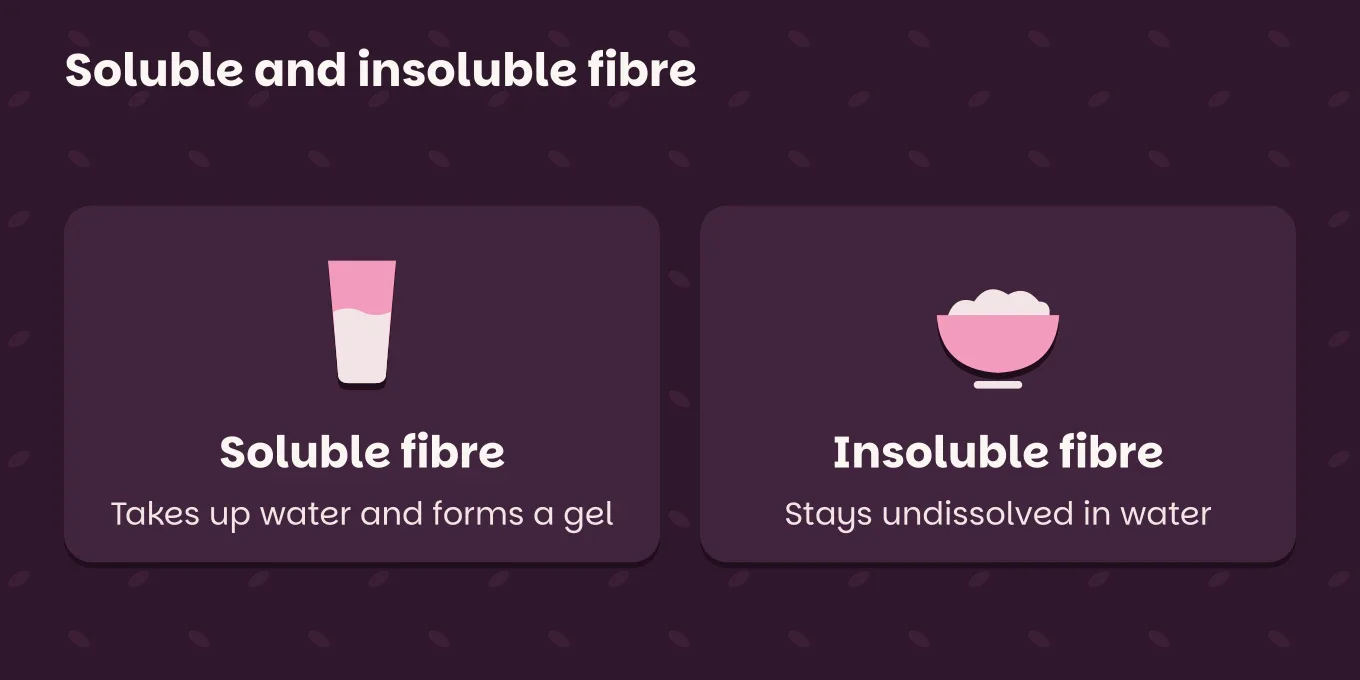
- Soluble fibre takes up water and forms a gel in your gut, so food moves through more slowly. Oat bran, barley, nuts, seeds, beans, lentils and peas contain it, as do some fruits and vegetables.
- Insoluble fibre stays undissolved in water. Wheat bran, vegetables and whole grains contain it.
The figure below sets the 2 types side by side.
Most high-fibre foods contain both types, in different amounts. That is why MedlinePlus advises eating a variety of vegetables, fruits, whole grains, legumes and beans [1].
Why fibre matters
The NHS (UK) says there is evidence that eating plenty of fibre is associated with a lower risk of heart disease, stroke, type 2 diabetes and bowel cancer [4]. "Associated with" means these go together in studies. It does not promise that any single food will prevent a disease.
The Dietary Guidelines for Americans 2025-2030 add a point about the gut. They say that vegetables, fruits, fermented foods and high-fibre foods support a diverse gut microbiome, which may be beneficial for health [5].

How much fibre do adults need?
National advice differs, so each figure below names its source. Each figure is set for a group of people, such as adults or an age and sex group.
Our approach: this guide reports these figures as published. It does not work out a personal fibre target for you.
- WHO: everyone older than 10, adults included, should aim for at least 25 g of naturally occurring dietary fibre a day [3].
- United Kingdom: the NHS says government guidelines set a dietary fibre intake of 30 g a day, and gives lower figures for children. It notes that most adults eat an average of only about 20 g a day [4].
- Canada: Health Canada's dietary reference intake tables list an adequate intake of total fibre of 38 g a day for men aged 19 to 50 and 30 g from age 51. For women, the figures are 25 g a day from 19 to 50 and 21 g from age 51 [6].
- United States: the Dietary Guidelines for Americans 2025-2030 give no daily gram figure for fibre. They ask Americans to prioritise fibre-rich whole grains [5]. MedlinePlus, from the US National Library of Medicine, gives 21 to 38 g a day for older children, adolescents and adults, and says Americans eat about 16 g a day on average [1].
Canada's figure is an "adequate intake" (AI). Health Canada defines it in these words [2]:
The AI is the recommended average daily nutrient intake level based on observed or experimentally determined approximations or estimates of nutrient intake by a group (or groups) of people who are assumed to be maintaining an adequate nutritional state. The AI is expected to meet or exceed the needs of most individuals in a specific life-stage and sex group. […] When an RDA isn't available for a nutrient, the AI can be used as the goal for usual intake by an individual.
An RDA is a recommended dietary allowance. Health Canada's table gives total fibre an AI and no RDA [6]. So, in Health Canada's own terms, the fibre AI can be used as the goal for an individual's usual intake [2, 6].
The figure below compares the 3 daily figures for adults: at least 25 g from WHO, 30 g in the UK, and 21 to 38 g in Canada, by age and sex.
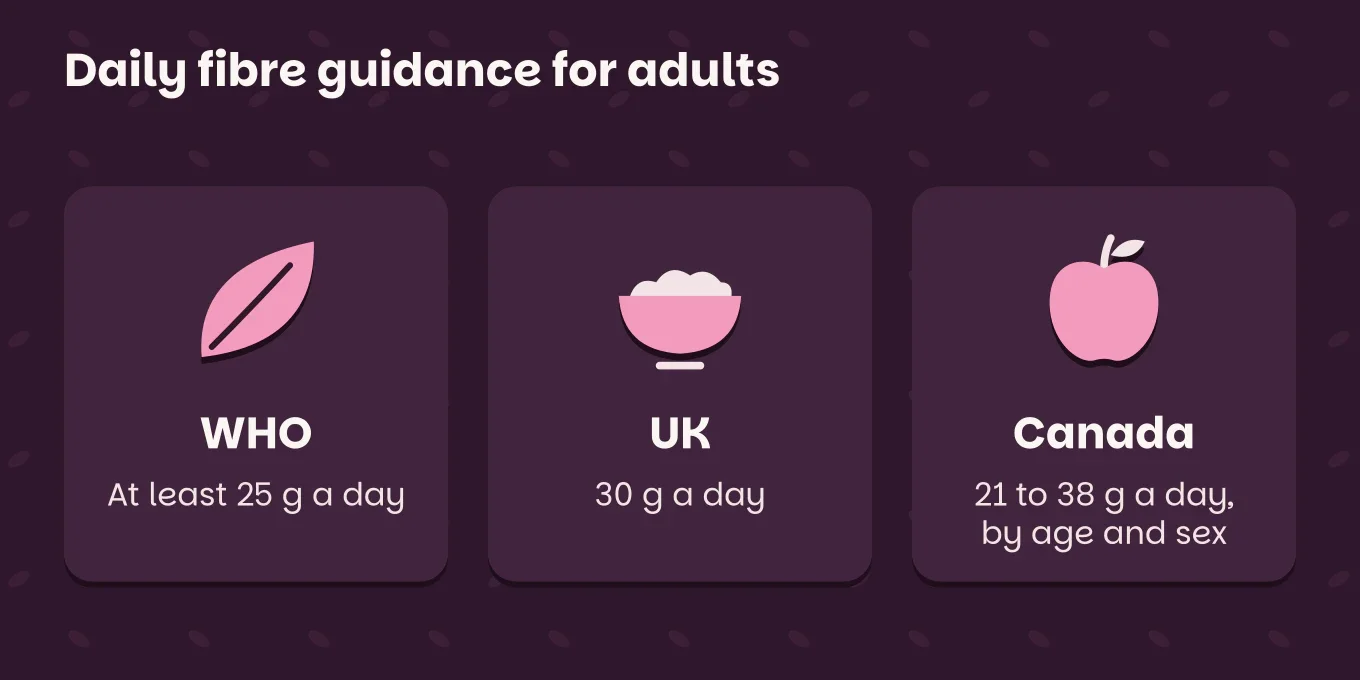
Guideline figure: at least 25 g of naturally occurring dietary fibre a day for everyone older than 10. Source: WHO, "Healthy diet" fact sheet, published 26 Jan 2026 [3]. United Kingdom: 30 g a day. Source: NHS, "How to get more fibre into your diet", page last reviewed 2 Mar 2026 [4]. Canada: an adequate intake of 21 to 38 g a day for adults, by age and sex. Source: Health Canada, "Dietary reference intakes tables: reference values for macronutrients", modified 19 Nov 2025 [6]. United States: 21 to 38 g a day for older children, adolescents and adults. Source: MedlinePlus, "Fiber", review date 22 Jul 2026 [1]. Average intakes: about 20 g a day for most UK adults [4], and about 16 g a day in the United States [1]. United Kingdom food labels: a high-fibre food has 6 g or more of fibre per 100 g [4]. We checked these figures on 18 Oct 2026. We recheck guideline figures every 6 months, so our next check is due by 18 Apr 2027.
If you have a medical condition or special dietary needs, the NHS advises you to ask a doctor or a registered dietitian for advice [7].
What counts as a high-fibre food?
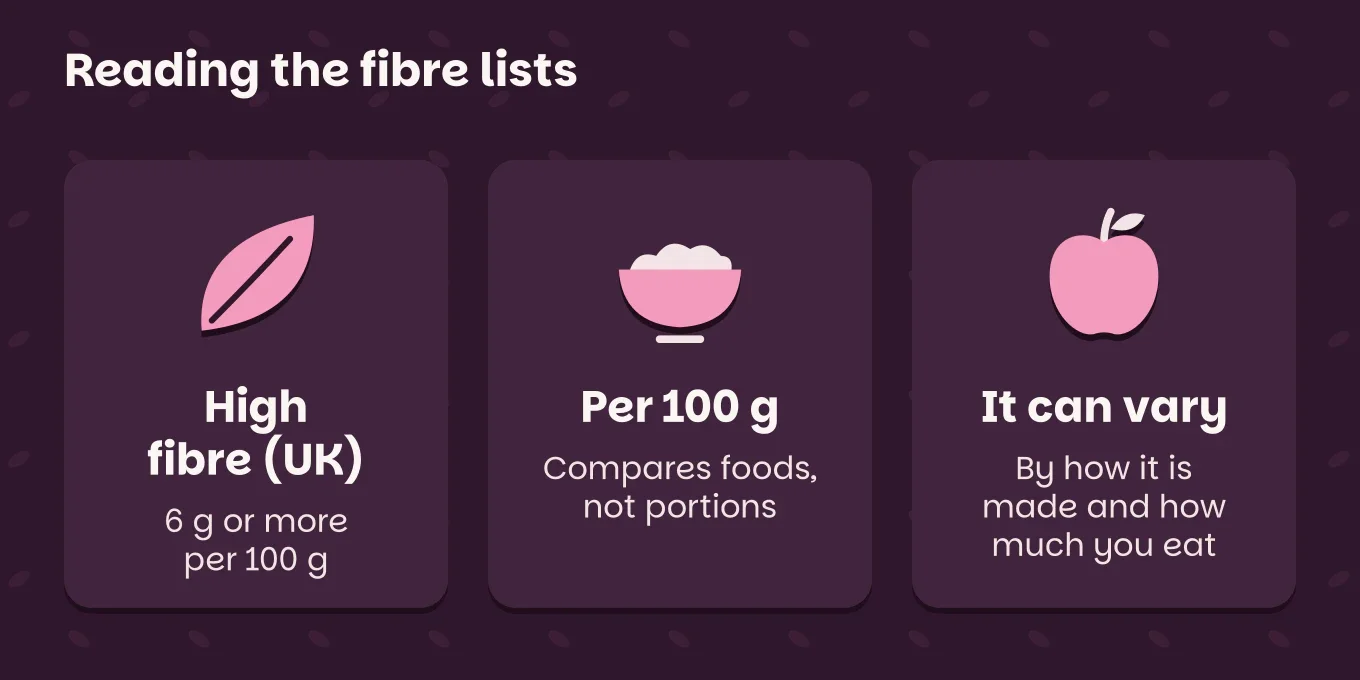
On UK food labels, a high-fibre food has 6 g or more of fibre in every 100 g [4]. That makes a handy yardstick for the lists below.
The lists give fibre in grams per 100 g of each food, in the form named in the table. The figures come from USDA FoodData Central, the US Department of Agriculture's food composition database [8]. Grams per 100 g let you compare foods. They do not tell you how much fibre is in your usual portion.
The NHS also notes that the amount of fibre in any food can depend on how it is made or prepared, and on how much of it you eat [4].
The figure below sums up these 3 points.
High-fibre foods by group
Beans, peas and lentils
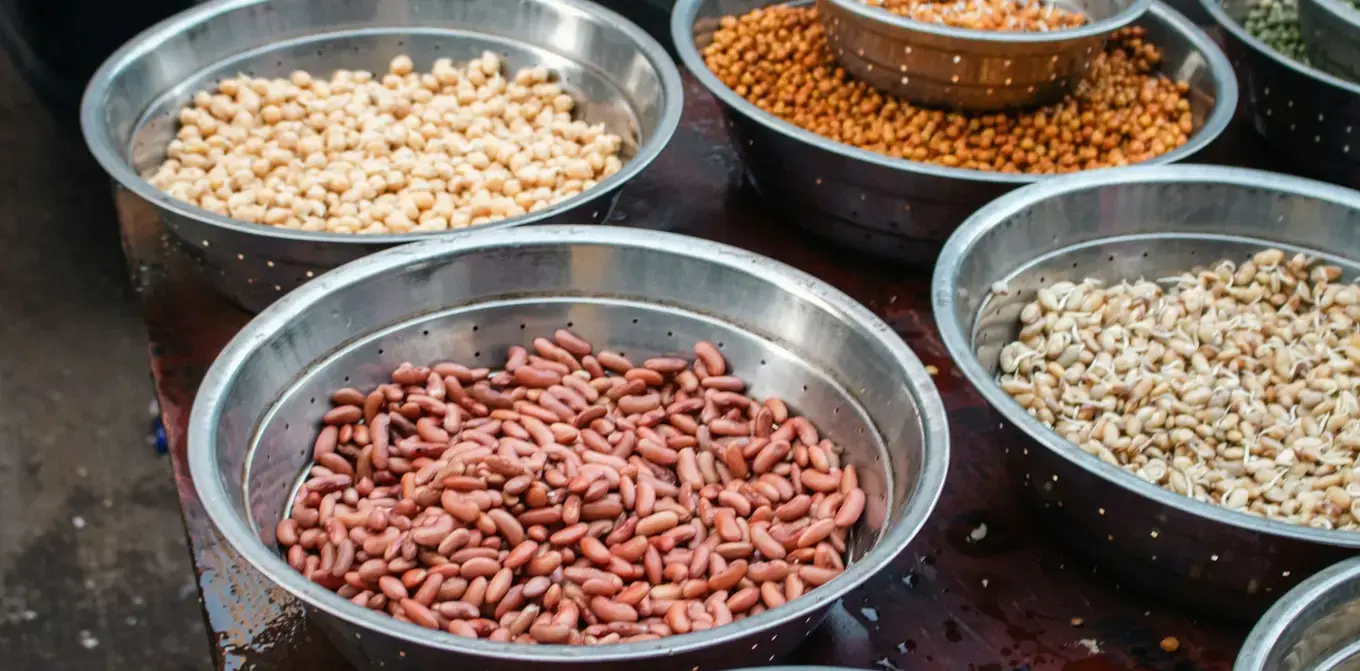
WHO counts pulses, such as lentils, chickpeas, beans and dried peas, among the foods that most carbohydrates should come from [3]. Most cooked beans, peas and lentils pass the UK mark of 6 g per 100 g [4, 8]:
| Food (cooked) | Fibre per 100 g |
|---|---|
| Black beans | 8.7 g |
| Split peas | 8.3 g |
| Lentils | 7.9 g |
| Chickpeas | 7.6 g |
| Kidney beans | 6.4 g |
| Edamame | 5.2 g |
The NHS suggests adding pulses like beans, lentils or chickpeas to stews, curries and salads [4]. The US guidelines list beans, peas and lentils among protein foods [5].
Whole grains
Whole grains vary widely in fibre [8]:
| Food | Fibre per 100 g |
|---|---|
| Oats, dry | 10.1 g |
| Wholewheat bread | 6.0 g |
| Bulgur wheat, cooked | 4.5 g |
| Wholewheat pasta, cooked | 3.9 g |
| Pearl barley, cooked | 3.8 g |
| Quinoa, cooked | 2.8 g |
| Brown rice, cooked | 1.6 g |
Oats are listed dry, before cooking, so their figure does not compare directly with the cooked foods in the table.
Vegetables
Vegetables have less fibre per 100 g than pulses or seeds, but you can add them to almost any meal [8]:
| Food | Fibre per 100 g |
|---|---|
| Green peas, frozen, cooked | 4.5 g |
| Broccoli, cooked | 3.3 g |
| Sweet potato, baked, flesh only | 3.3 g |
| Carrots, cooked | 3.0 g |
| Brussels sprouts, cooked | 2.6 g |
| Potato, baked, with skin | 2.2 g |
| Spinach, raw | 2.2 g |
The NHS suggests including plenty of vegetables with meals, either as a side dish or added to sauces, stews or curries. It also suggests that you eat potatoes with their skins on [4].
Fruit
In this list, dried figs, avocado and berries have the most fibre [8]:
| Food | Fibre per 100 g |
|---|---|
| Figs, dried | 9.8 g |
| Avocado | 6.7 g |
| Raspberries | 6.5 g |
| Blackberries | 5.3 g |
| Pear | 3.1 g |
| Banana | 2.6 g |
| Apple, with skin | 2.4 g |
| Orange | 2.4 g |
Dried fruit is sticky and can raise the risk of tooth decay. The NHS says it is better eaten as part of a meal than as a snack between meals [4].
Nuts and seeds
Chia seeds, flaxseed and almonds have the most fibre per 100 g of any food in these lists [8]. The NHS suggests a small handful of nuts as a snack [4].
| Food | Fibre per 100 g |
|---|---|
| Chia seeds | 34.4 g |
| Flaxseed (linseed) | 27.3 g |
| Almonds | 12.5 g |
| Sunflower seeds, dry-roasted | 11.1 g |
| Peanuts, dry-roasted | 8.4 g |
Nuts are high in fibre, but they also contain a lot of fat, so the NHS advises eating them in moderation [7]. Choose unsalted nuts without added sugars [4].
Whole fruit or juice?
If you want fibre, eat the fruit rather than drink the juice. A raw orange has 2.4 g of fibre per 100 g. Fresh orange juice has 0.2 g [8].
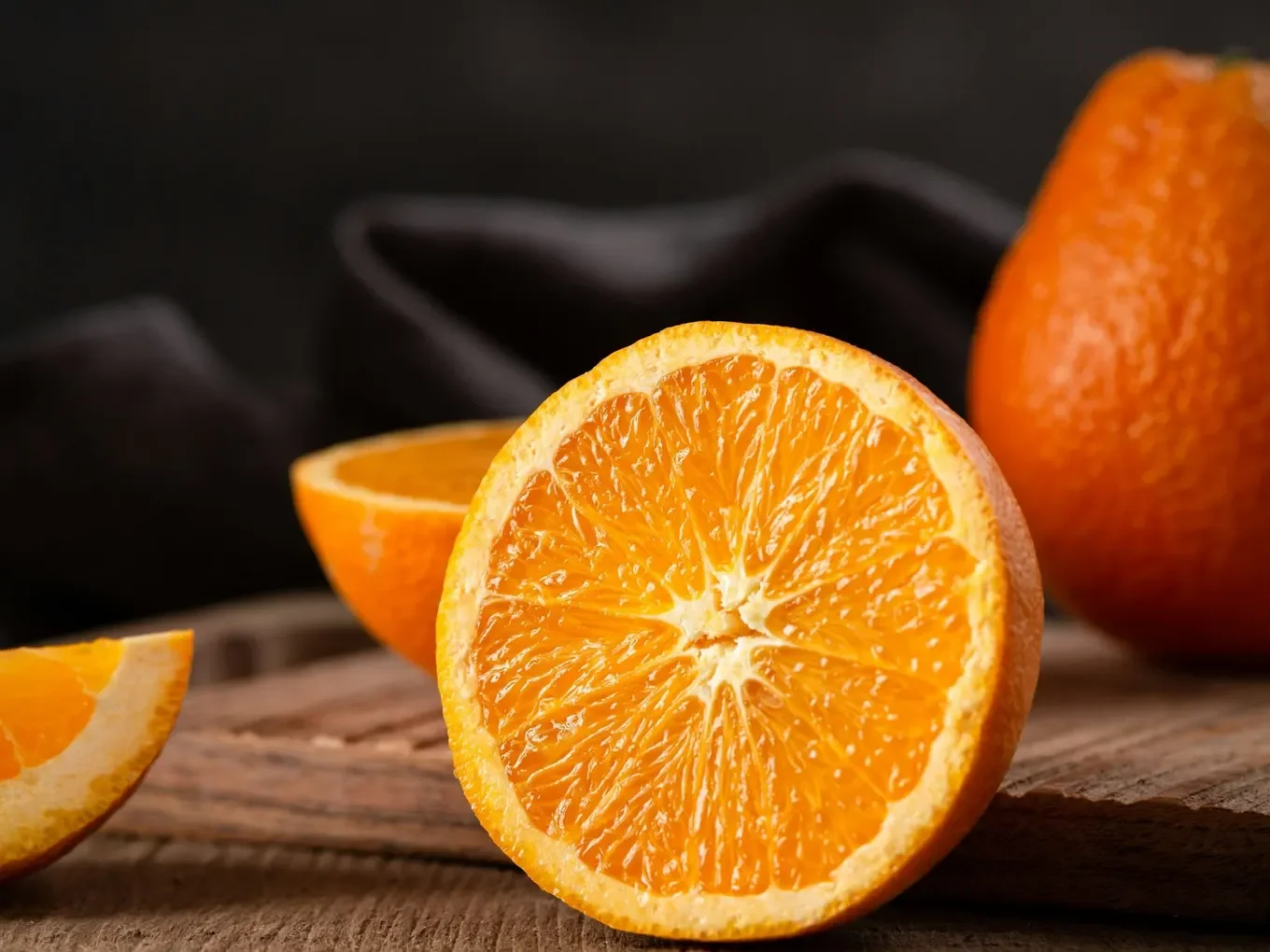
The US guidelines advise eating whole fruits and vegetables in their original form, and having 100% fruit or vegetable juice only in limited portions or diluted with water [5]. WHO notes that most fruit juices, including those without added sugars, contain significant amounts of free sugars, which should be limited [3].
Easy swaps that add fibre
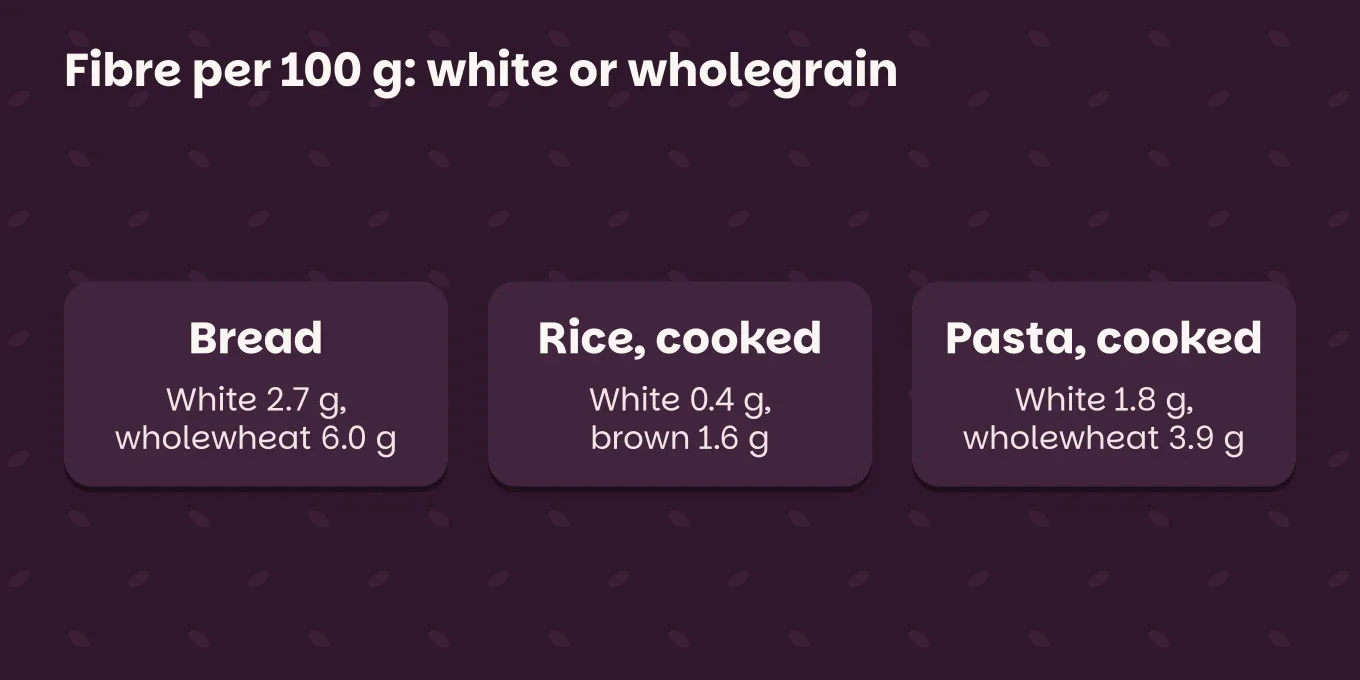
The NHS says wholegrain varieties of starchy foods contain more fibre than white varieties [7]. The figure below compares white and wholegrain versions of 3 staples, per 100 g [8]:
- Bread: white bread has 2.7 g, wholewheat bread 6.0 g.
- Rice: cooked white rice has 0.4 g, cooked brown rice 1.6 g.
- Pasta: cooked white pasta has 1.8 g, cooked wholewheat pasta 3.9 g.
The NHS suggests these swaps and a few more [4]:
- Choose a higher-fibre breakfast cereal, such as plain wholewheat or shredded wholegrain cereal, or porridge.
- Go for wholemeal or granary bread, or higher-fibre white bread.
- Choose wholegrains like wholewheat pasta, bulgur wheat or brown rice.
- For snacks, try fresh fruit, vegetable sticks, rye crackers, oatcakes, and unsalted nuts or seeds.
The US guidelines also advise cutting back sharply on highly processed, refined carbohydrates, such as white bread and packaged breakfast options [5].
What 30 g of fibre a day looks like
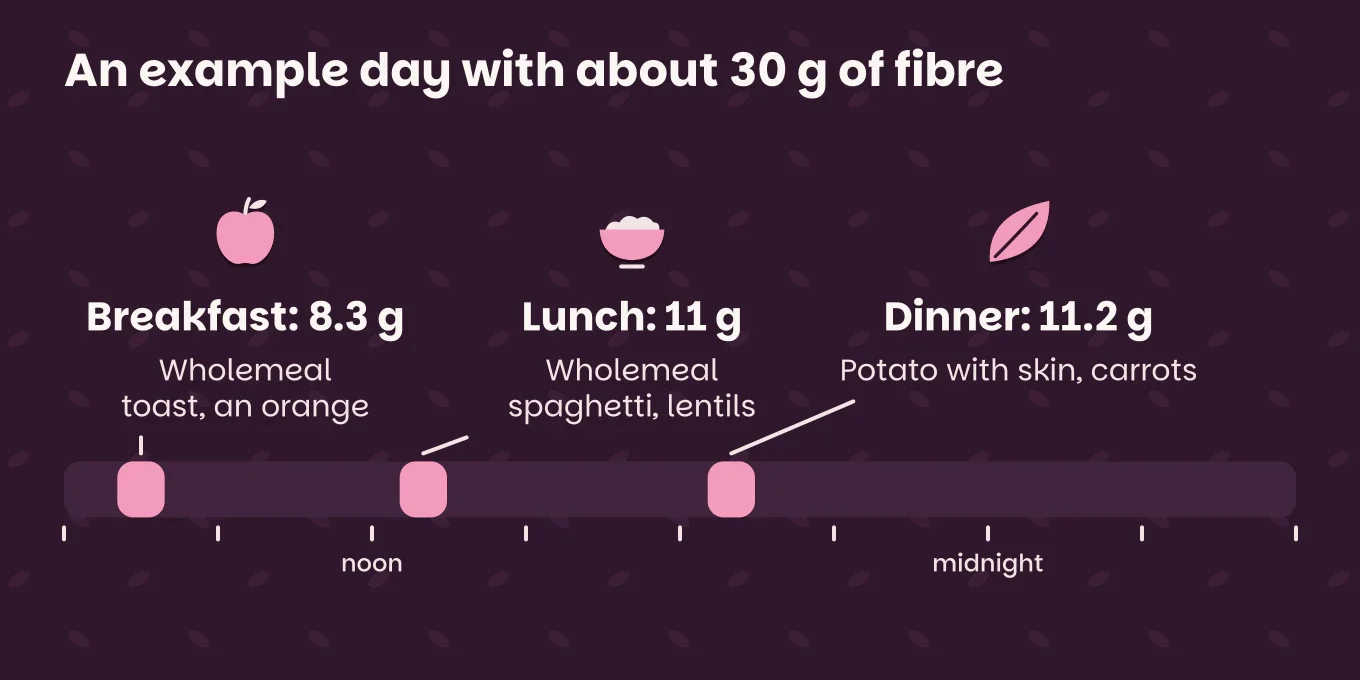
The NHS gives 3 example meals [4]:
- Breakfast: 2 slices of wholemeal toast with peanut butter, then a medium orange. Around 8.3 g of fibre.
- Lunch: wholemeal spaghetti with a lentil and tomato sauce. Around 11 g.
- Dinner: grilled chicken breast, a baked potato with its skin on, carrots and green beans. Around 11.2 g.
By our sum, the 3 meals add up to about 30.5 g, close to the UK figure of 30 g. The figure below places them across a day: breakfast with around 8.3 g, lunch with around 11 g, and dinner with around 11.2 g [4].
The NHS says these meals are only illustrations. The fibre in a meal can depend on how the food is made and how much you eat [4].
How to add fibre comfortably
A sudden jump in fibre can leave you with wind, a bloated feeling or cramps. According to MedlinePlus, this often settles as the bacteria in your gut adjust to the change [1].
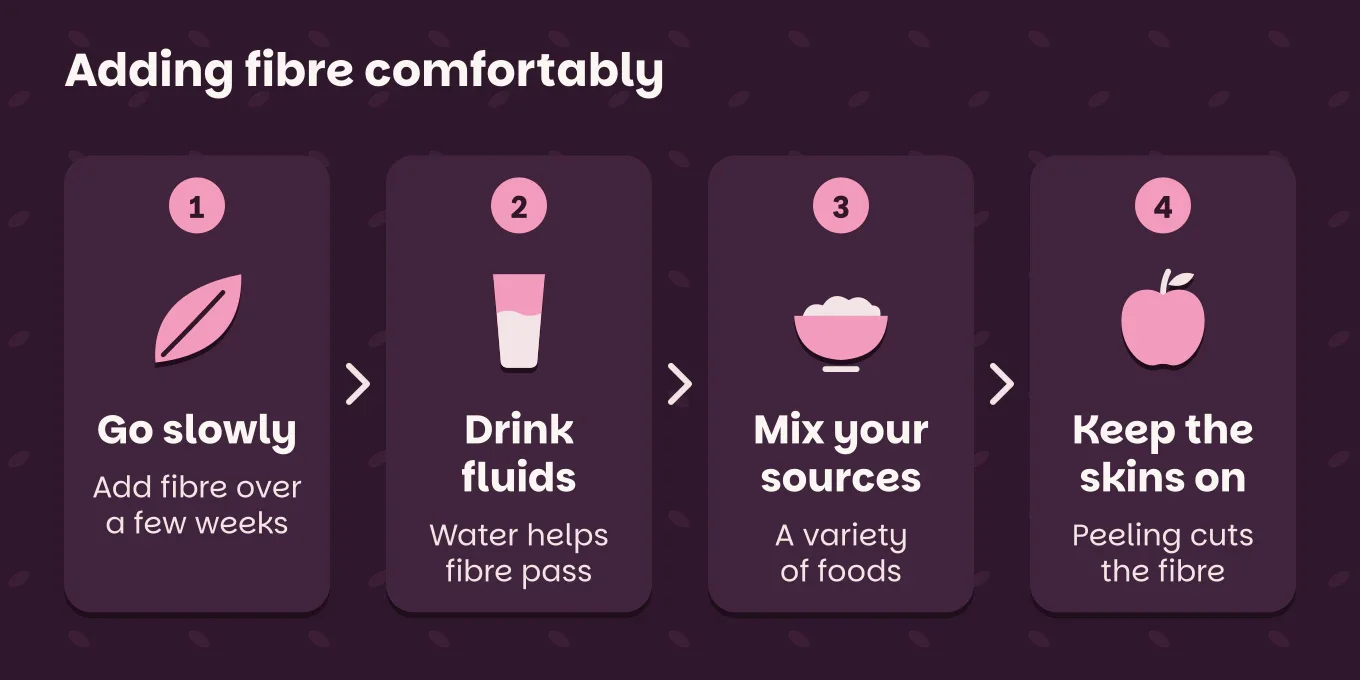
The figure below shows 4 habits that help:
- Go slowly. Add fibre gradually, over a few weeks [1].
- Drink fluids. Water helps fibre pass through the digestive system, so drink plenty of fluids [1].
- Mix your sources. The NHS says it is important to get fibre from a variety of sources [4].
- Keep the skins on. Peeling fruits and vegetables reduces the fibre you get from them [1].
Can you have too much fibre? Very large amounts can reduce how well your body takes up minerals such as iron, zinc, magnesium and calcium. MedlinePlus says this is rarely a worry, since foods high in fibre tend to be rich in minerals [1].
This guide covers fibre from food only. It does not cover fibre supplements.
See a doctor if
- You have a medical condition or special dietary needs and plan to change your diet. The NHS advises you to ask a doctor or a registered dietitian [7].
- You have a long-term condition. The US guidelines advise you to talk with your health care professional about whether you need to adapt the general advice [5].
- You feel bloated regularly [9].
- You have changed your diet but keep feeling bloated [9].
- You have bloating and lose weight without trying [9].
- You have bloating and blood in your poo [9].
- You have bloating with any of these: vomiting, diarrhoea or constipation; a stomach ache; a high temperature, or you feel hot, cold or shivery; a swelling or lump in your tummy; you cannot pee, poo or fart; or a burning feeling in your chest from acid reflux. In the UK, the NHS says to ask for an urgent GP appointment or call 111. Elsewhere, get urgent medical advice [9].
- You have bloating with a swollen stomach and any of these: a stomach ache that is severe and came on very suddenly; vomiting blood, or vomit that looks like ground coffee; or severe difficulty breathing. In the UK, the NHS says to go to A&E or call 999; elsewhere, call your local emergency number [9].
How we made this article. We researched it with AI assistance. We then fact-checked every claim against the sources below. Editorial policy
Sources
All sources checked . Found an error? Tell us.
- 1MedlinePlus, US National Library of Medicine (United States). Fiber (opens in a new tab). medlineplus.gov. Review date 22 Jul 2026. Checked 18 Oct 2026.
- 2Health Canada (Canada). Dietary reference intakes tables (opens in a new tab). canada.ca. Date modified 19 Nov 2025. Checked 18 Oct 2026.
- 3World Health Organization. Healthy diet (opens in a new tab). Fact sheet. who.int. Published 26 Jan 2026. Checked 18 Oct 2026.
- 4NHS (United Kingdom). How to get more fibre into your diet (opens in a new tab). nhs.uk. Page last reviewed 2 Mar 2026. Checked 18 Oct 2026.
- 5US Department of Agriculture and US Department of Health and Human Services (United States). Dietary Guidelines for Americans, 2025-2030 (opens in a new tab). realfood.gov. Published Jan 2026. Checked 18 Oct 2026.
- 6Health Canada (Canada). Dietary reference intakes tables: reference values for macronutrients (opens in a new tab). canada.ca. Date modified 19 Nov 2025. Checked 18 Oct 2026.
- 7NHS (United Kingdom). Eating a balanced diet (opens in a new tab). nhs.uk. Page last reviewed 30 Jun 2026. Checked 18 Oct 2026.
- 8US Department of Agriculture, Agricultural Research Service (United States). FoodData Central (opens in a new tab). SR Legacy data, final release Apr 2018, "Fiber, total dietary" per 100 g. FDC IDs: black beans 173735, split peas 172429, lentils 172421, chickpeas 173757, kidney beans 173740, edamame 168411, oats 173904, wholewheat bread 172688, bulgur 170287, wholewheat pasta 168910, pearl barley 170285, quinoa 168917, brown rice 169704, green peas 170017, broccoli 169967, sweet potato 168483, carrots 170394, Brussels sprouts 169971, potato 170093, spinach 168462, dried figs 174665, avocado 171705, raspberries 167755, blackberries 173946, pear 169118, banana 173944, apple 171688, orange 169097, orange juice 169098, chia seeds 170554, flaxseed 169414, almonds 170567, sunflower seeds 170563, peanuts 173806, white bread 174924, white rice 168878, white pasta (enriched, cooked) 169737. Checked 18 Oct 2026.
- 9NHS (United Kingdom). Bloating (opens in a new tab). nhs.uk. Page last reviewed 21 Jan 2026. Checked 18 Oct 2026.