Balanced diet basics: what national food guides agree on
What a balanced diet looks like, based on WHO advice and the UK, US and Canadian food guides: food groups, plate shares, fats, sugar, salt and drinks.
- Published
- Last checked

A balanced diet is not a single menu or a list of banned foods. It is a pattern: a wide mix of foods from a few main groups, in sensible proportions, most of the time.
This guide sets out what the World Health Organization (WHO) and 3 national food guides say a balanced diet looks like for adults. The national guides come from the United Kingdom, the United States and Canada. Where they agree, we say so. Where they differ, we name the country.
What "balanced" means
WHO describes a healthy diet with 4 principles [1]:
- Adequacy. You get enough of the nutrients you need, without going over.
- Balance. The energy you take in matches the energy you use, and it comes from a sensible mix of protein, fats and carbohydrates.
- Moderation. You limit foods and nutrients that can harm health.
- Diversity. You eat a wide variety of foods, both across food groups and within them.
WHO also notes that the exact make-up of a healthy diet varies with age, gender, lifestyle, activity, culture, local foods and customs [1]. The principles stay the same. So a balanced diet in Japan, Kenya or Canada can look very different on the plate and still follow the same rules.
You do not need to get the balance right at every meal. The UK Eatwell Guide says to aim for it over a day, or even a week [2].
The foods every guide includes
The guides group foods in different ways, but the same kinds of food appear in each:
- Vegetables and fruit. Half the plate in Canada's food guide [3], and just over a third of what you eat in the UK Eatwell Guide [2].
- Starchy foods and whole grains. Such as potatoes, bread, rice, pasta, oats and other grains [2, 3].
- Protein foods. Beans, peas, lentils, nuts, fish, eggs, meat and other protein foods [2, 4, 5].
- Dairy or alternatives. Milk, yoghurt and cheese, or fortified plant-based drinks such as soya [6, 7].
- Fats and oils. In small amounts, with unsaturated oils preferred [2, 4].
The groupings differ. Canada's plate has 3 parts, and Canada counts lower-fat milk, yogurt and cheese as protein foods [3, 8]. The US pyramid puts protein, dairy and healthy fats together in 1 band [5].
Foods high in fat, salt and sugar sit outside the main groups in the UK guide. It says they are not needed in a healthy, balanced diet, so you should have them less often and in small amounts [2]. Canada's food guide advises you to limit highly processed foods [4], and the US guidelines go further and advise you to avoid them [5].
Fruit and vegetables: how much?
WHO, the UK and Canada each give an amount for fruit and vegetables, in different ways:
- WHO: everyone older than 10 should aim for at least 400 g of fruit and vegetables a day [1].
- United Kingdom: eat at least 5 portions a day, the "5 A Day" target. A portion is 80 g of fresh, canned or frozen fruit or vegetables [6]. Fruit and vegetables should make up just over a third of what you eat each day [2].
- Canada: make half your plate vegetables and fruits [3].
The UK and WHO figures line up: 5 portions of 80 g come to 400 g. Fig. 1 compares the 3 ways of saying it.
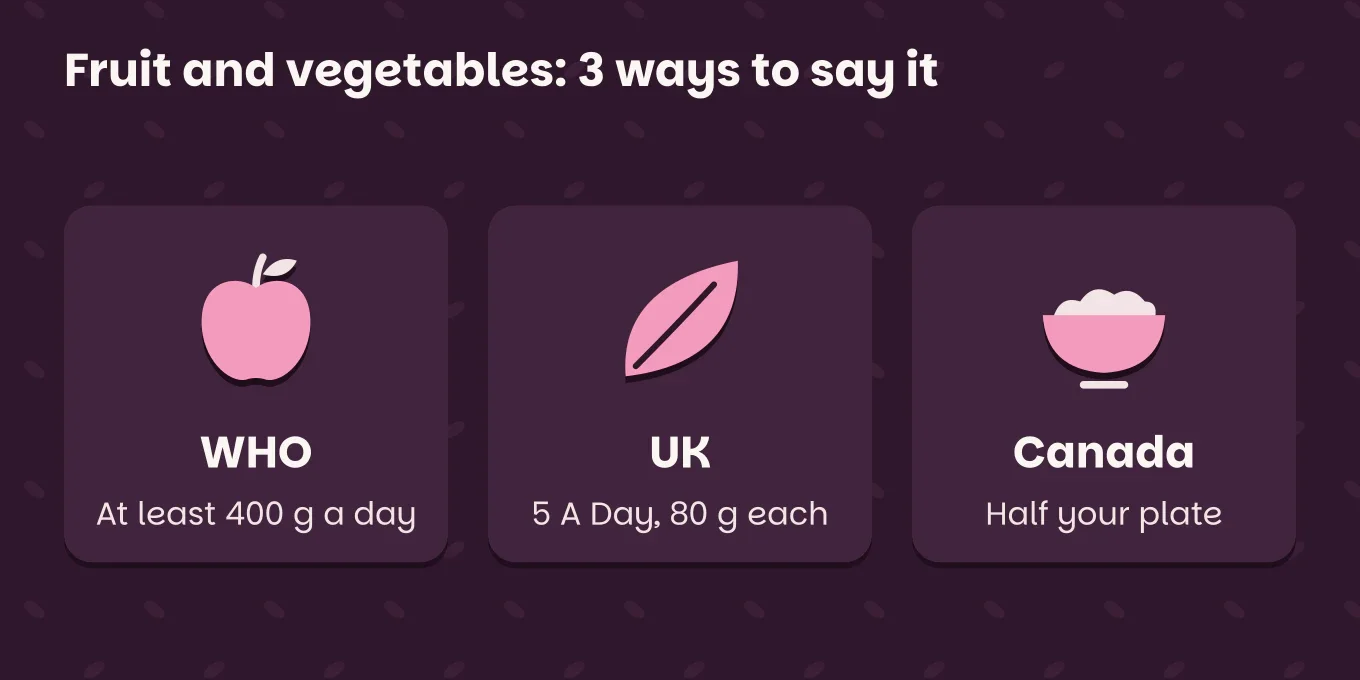
Guideline figure: at least 400 g of fruit and vegetables a day for everyone older than 10. Source: WHO, "Healthy diet" fact sheet, published 26 Jan 2026 [1]. United Kingdom: at least 5 portions of 80 g a day. Source: NHS, "Eating a balanced diet", page last reviewed 30 Jun 2026 [6]. We checked this figure on 18 Oct 2026. We recheck guideline figures every 6 months, so our next check is due by 18 Apr 2027.
Fresh, frozen and canned all count [1, 2, 3], and the UK and Canada count dried too [2, 3]. Choose canned and frozen options without added sugar or a lot of salt [1]. Fruit juice counts in the UK, but only up to 150 ml a day in total with smoothies, because juice contains free sugars [2, 6].
Starchy foods and whole grains
In the UK guide, starchy foods such as potatoes, bread, rice and pasta should make up just over a third of what you eat [2, 6]. The guide suggests higher-fibre or wholegrain versions, and leaving the skins on potatoes [2]. Canada's plate gives whole grain foods a quarter of the plate [3]. The US guidelines ask you to choose fibre-rich whole grains and to cut down on refined carbohydrates such as white bread and packaged breakfast foods [5].
WHO says most carbohydrates should come from whole grains, vegetables, fruits and pulses, such as lentils, chickpeas and beans [1]. It also advises everyone older than 10 to aim for at least 25 g of naturally occurring dietary fibre a day [1]. Whole grains, pulses, fruit and vegetables are where that fibre comes from.
Protein foods
Protein foods include beans, peas, lentils, nuts, seeds, fish, eggs, dairy and meat. The guides agree that a mix of animal and plant sources works [1, 5]. Where they differ is emphasis:
- WHO says that for many adults, a shift towards more plant-based protein may bring health benefits, especially a shift away from red meat [1].
- Canada advises you to choose protein foods from plants more often [4].
- The United Kingdom suggests beans and pulses as good alternatives to meat, lean cuts when you do eat meat, and less red and processed meat. It also advises at least 2 portions of fish a week, 1 of them oily, such as salmon, sardines or mackerel [2, 6].
- The United States asks you to prioritise protein foods at every meal, from both animal and plant sources [5].
Dairy and alternatives
Milk, cheese and yoghurt are good sources of protein and calcium [6]. Here the national guides differ on fat:
- United Kingdom: choose lower-fat and lower-sugar dairy, such as semi-skimmed or 1% milk. If you use alternatives such as soya drinks, choose unsweetened ones fortified with vitamins and minerals [6].
- Canada: lists unsweetened lower-fat milk and unsweetened fortified plant-based drinks as healthy drink options after water [7].
- United States: the 2025-2030 guidelines say to include full-fat dairy with no added sugars [5].
All 3 agree that dairy foods and drinks are best without added sugar.
Fats: mostly unsaturated, in small amounts
Some fat is essential. WHO notes that your body needs certain fatty acids that it can only get from food [1]. What matters most is the type:
- Unsaturated fats are the better choice. They are found in fish, avocados, nuts, and in sunflower, soybean, rapeseed (canola) and olive oils [1, 2].
- Saturated fats are found in fatty meat, butter, palm and coconut oil, cream, cheese, ghee and lard [1].
- Trans fats produced by industry are found in some baked and fried foods and pre-packaged snacks. WHO says they are not part of a healthy diet [1].
WHO advises that no more than 10% of total energy intake comes from saturated fat, and no more than 1% from trans fat [1]. The US guidelines use the same 10% limit for saturated fat [5]. The UK guide reminds you that all fats are high in energy, so use oils and spreads in small amounts [2, 6].
Sugar and salt
WHO notes that many people now eat more processed foods high in free sugars and salt [1]. Free sugars are sugars added to food and drinks, plus the sugars in honey, syrups and fruit juice [1].
- Free sugars: WHO advises less than 10% of total energy intake, and says that 5% or less may bring extra benefits [1]. The US guidelines say no amount of added sugar is recommended, and that a meal should contain no more than 10 g of added sugars [5].
- Salt: WHO advises adults to eat less than 5 g of salt a day, which is 2 g of sodium [1]. The US figure is less than 2,300 mg of sodium a day for everyone aged 14 and over [5].
Much of the salt people eat is already in food when they buy it, such as ready meals, processed meats, cheese, salty snacks and bread [1]. Canada's food guide encourages you to cook more often [4], and the US guidelines favour home-prepared meals [5].
Fig. 2 shows the WHO limits: free sugars under 10% of energy, saturated fat at 10% of energy or less, and salt under 5 g a day [1].
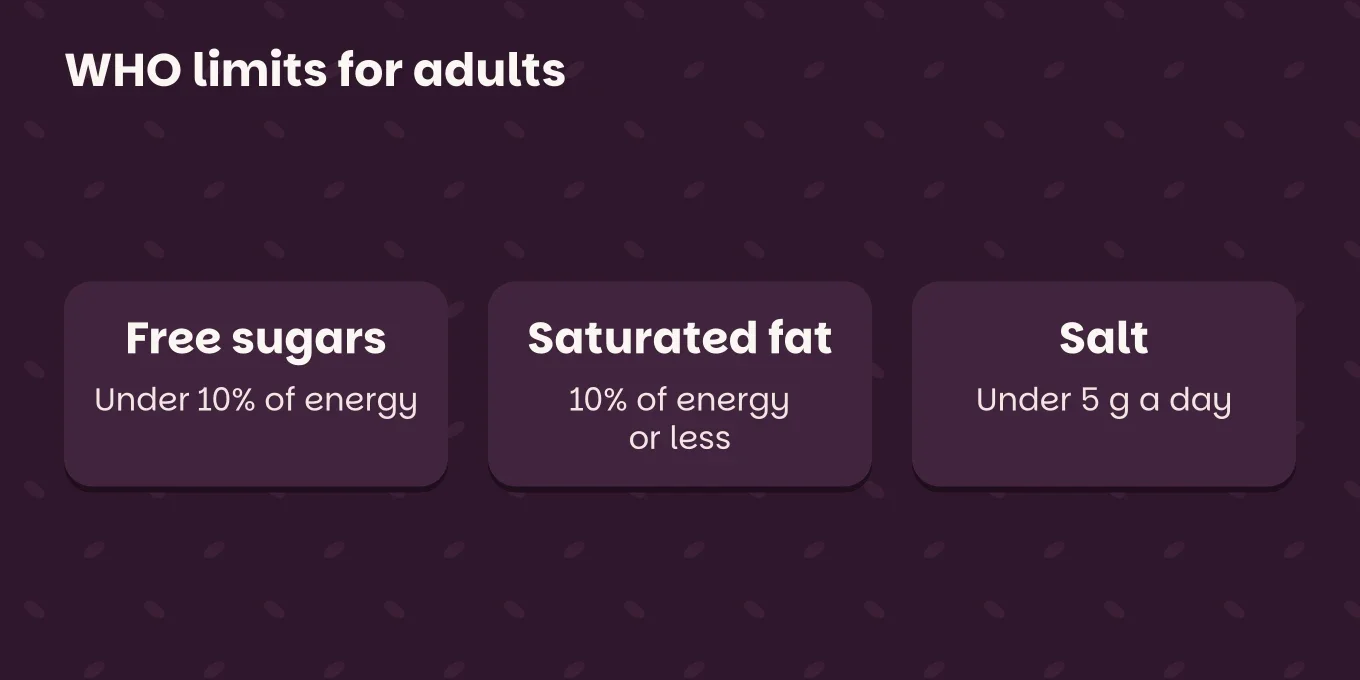
Guideline figure: free sugars under 10% of total energy intake, saturated fat 10% or less, trans fat 1% or less, and salt under 5 g a day for adults. Source: WHO, "Healthy diet" fact sheet, published 26 Jan 2026 [1]. United States: sodium under 2,300 mg a day from age 14. Source: Dietary Guidelines for Americans, 2025-2030, published Jan 2026 [5]. We checked this figure on 18 Oct 2026. We recheck guideline figures every 6 months, so our next check is due by 18 Apr 2027.
Drinks
Each national guide names water first in its drinks advice [2, 5, 7], but only Canada ranks it above other drinks. Canada's food guide says to make water your drink of choice [7]. The US guidelines advise water and unsweetened drinks, and advise you to avoid sugar-sweetened drinks such as soda and energy drinks [5].
The UK government recommends 6 to 8 cups or glasses of fluid a day as a guide [2, 6]. Water, lower-fat milk, sugar-free drinks, tea and coffee all count [2].
How to build a balanced plate
Canada's food guide plate is a simple way to put this together at a meal [3]. Fig. 3 shows the steps:
- Fill half your plate with vegetables and fruits [3].
- Fill a quarter with whole grain foods [3], such as brown rice or oats [1].
- Fill a quarter with protein foods, and choose plants more often [3].
- Make water your drink [7].
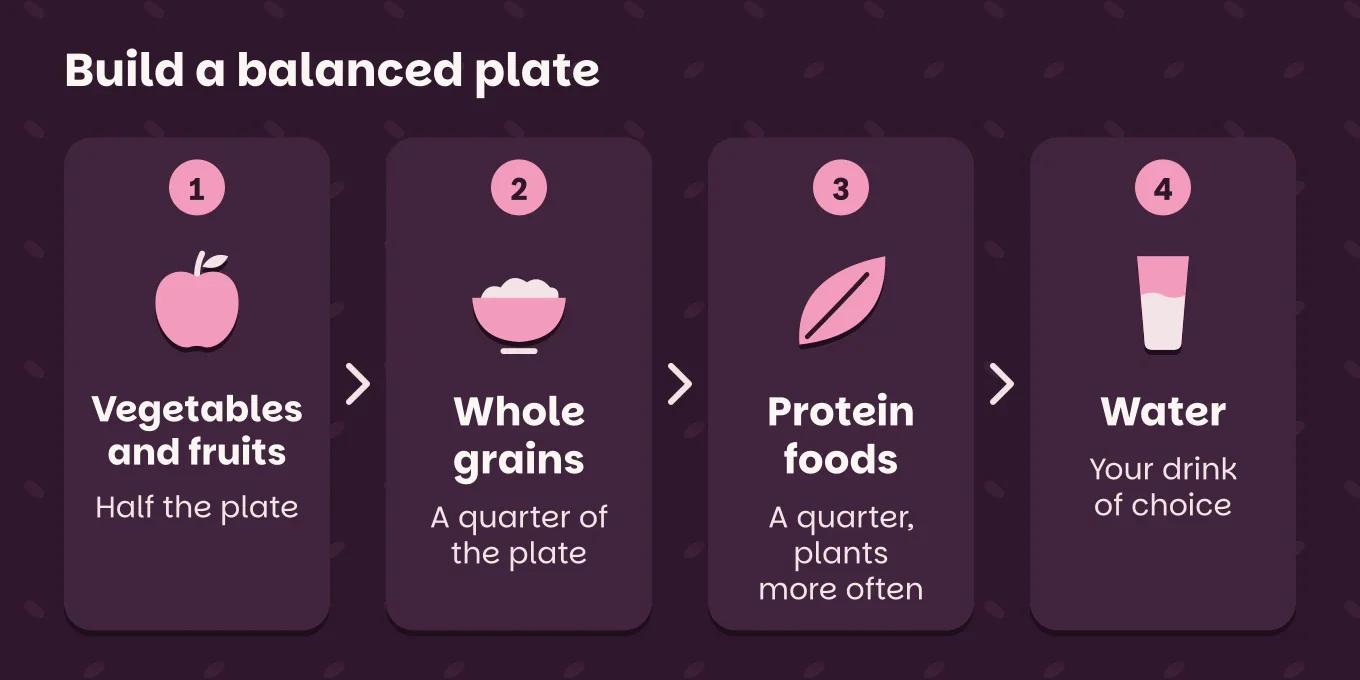
The plate shows proportions, not portion sizes. Health Canada says the size and amount of each food on the plate is not meant to show how much to eat at a time, and that some people need more food than others [3].
Many dishes, such as pizzas, stews, pasta dishes and sandwiches, mix several groups at once. The UK guide suggests that you check what is in them and think about where each part fits [2].
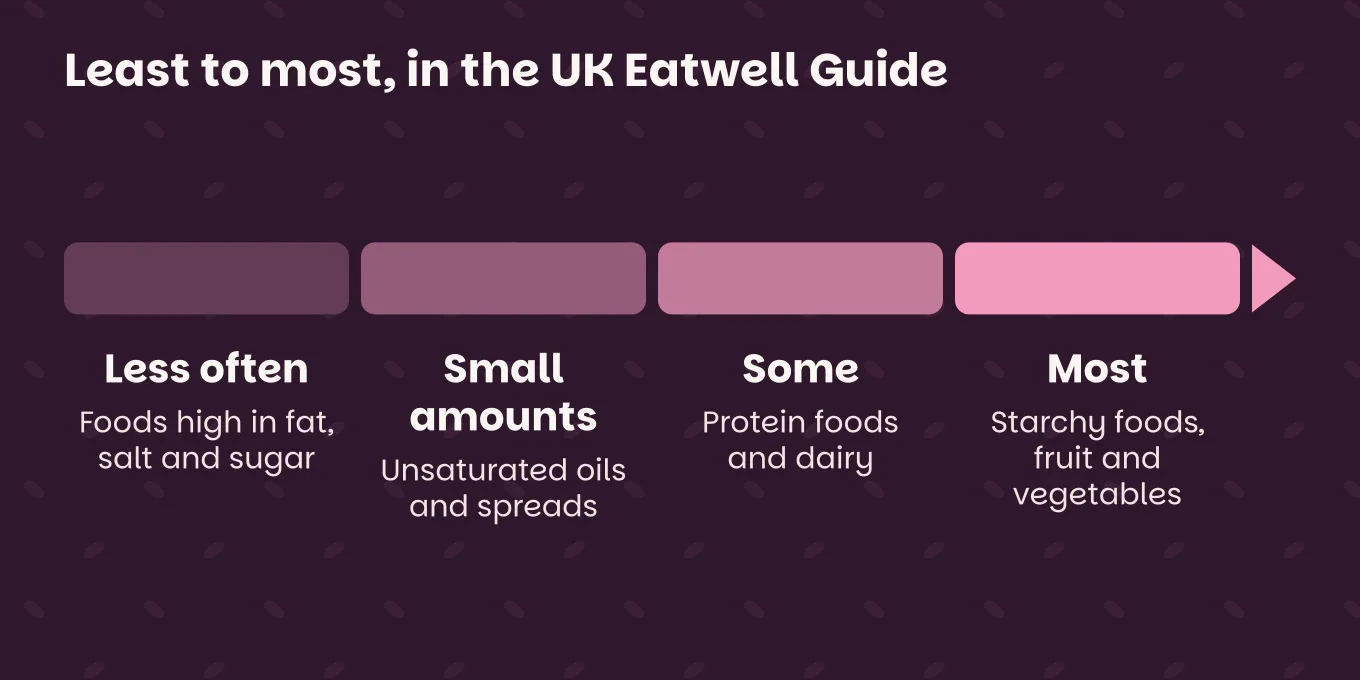
Fig. 4 orders the UK groups from least to most. Eat foods high in fat, salt and sugar less often. Use unsaturated oils and spreads in small amounts. Have some protein foods and dairy. Eat the most starchy foods, fruit and vegetables, and base meals on starchy foods [2].
Eating well on a budget
You do not need special foods to eat a balanced diet. Every guide here counts frozen and canned fruit and vegetables, not only fresh [1, 2, 3, 5]. The UK, US and Canadian guides count dried fruit too [2, 5, 3]. Canada's food guide also suggests that you cook more often, plan what you eat, and involve others in planning and preparing meals [4].
Where the guides differ
The core message is the same everywhere: plenty of vegetables, fruit, whole grains and varied protein foods, with less salt, sugar and saturated fat. The details differ by country:
- The picture. The UK uses the Eatwell Guide and Canada uses a plate [2, 3]. The US 2025-2030 guidelines, published in January 2026, use a pyramid with protein, dairy and healthy fats, vegetables and fruits, and whole grains [5].
- Dairy fat. The UK advises lower-fat dairy, and Canada lists lower-fat dairy among its protein foods. The US includes full-fat dairy [6, 8, 5].
- Protein. WHO and Canada lean towards more plant protein. The US asks you to prioritise protein foods at every meal [1, 4, 5].
- Sodium. WHO sets a limit of under 2 g of sodium a day for adults. The US limit is under 2,300 mg [1, 5].
If you live in the UK, the US or Canada, your national guide is written for your food supply and habits. If you live elsewhere, the WHO principles are a sound base.
See a doctor if
- You have a medical condition or special dietary needs. The NHS advises you to ask your doctor or a registered dietitian for advice [6].
- You have a long-term condition, such as heart disease or type 2 diabetes, and want to adapt the general advice. The US guidelines advise you to talk to your health care professional about it [5].
- You have kidney disease, or a doctor has told you that you are at risk of a high blood potassium level, and you are thinking about a lower-sodium salt substitute. These products swap some sodium for potassium. WHO says they suit people who are not at risk of high blood potassium [1].
How we made this article. We researched it with AI assistance. We then fact-checked every claim against the sources below. Editorial policy
Sources
All sources checked . Found an error? Tell us.
- 1World Health Organization. Healthy diet. Fact sheet. who.int. Published 26 Jan 2026. Checked 18 Oct 2026.
- 2NHS (United Kingdom). The Eatwell Guide. nhs.uk. Page last reviewed 29 Nov 2022. Checked 18 Oct 2026.
- 3Health Canada (Canada). Make healthy meals with Canada's food guide plate. canada.ca. Page date 20 May 2026. Checked 18 Oct 2026.
- 4Health Canada (Canada). Healthy eating recommendations. Canada's food guide. canada.ca. Page date 4 May 2026. Checked 18 Oct 2026.
- 5US Department of Agriculture and US Department of Health and Human Services (United States). Dietary Guidelines for Americans, 2025-2030. realfood.gov. Published Jan 2026. Checked 18 Oct 2026.
- 6NHS (United Kingdom). Eating a balanced diet. nhs.uk. Page last reviewed 30 Jun 2026. Checked 18 Oct 2026.
- 7Health Canada (Canada). Make water your drink of choice. Canada's food guide. canada.ca. Page date 23 Apr 2026. Checked 18 Oct 2026.
- 8Health Canada (Canada). Eat protein foods. Canada's food guide. canada.ca. Page date 4 May 2026. Checked 18 Oct 2026.